bag manufacturing cost is the first checkpoint buyers should lock before they approve a supplier, budget, or production slot. You have two quotes on your desk for what looks like the exact same backpack. One is $12.00, the other is $15.60. Understanding the real drivers of bag manufacturing cost is knowing that the extra $3.60 isn’t just supplier margin—it’s the price of predictability. I once saw a brand owner get burned on a $50,000 order because the mass-produced bags didn’t match the beautiful pre-production unit from the sample approval stage. The fabric dye lot was off, the zippers felt flimsy, and the whole shipment was a loss.
That disaster wasn’t about a bad quote. It was about not knowing what the quote was actually buying. The cheaper price came from a factory that couldn’t lock in the exact fabric from the same mill for the main run. The higher price baked in the cost of securing that material upfront and a stricter quality tolerance for the assembly line. Getting a handle on your unit cost means looking past the final number and dissecting the inputs: the material, the labor time tied to complexity, and the minimums dictated not by the factory, but by their raw material suppliers.
What is MOQ (Quantité minimum de commande) in Bag Manufacturing?
The real reason for a factory’s MOQ isn’t their production line—it’s the fabric mill’s minimum order for a single roll of custom-dyed.
Buyers often think a factory’s Minimum Order Quantity is an arbitrary number designed to force larger orders. It’s not. The factory’s capacity is rarely the issue; the constraint comes from one level higher up the supply chain.
Why Factories Have MOQs: Material Sourcing and Line Efficiency
The primary driver for what is a factory MOQ for bags is the raw material. A fabric mill won’t fire up its dyeing vats to produce 300 yards of your specific Pantone color. They have their own minimums, often 3,000 à 5,000 yards per color. A bag factory must purchase that entire roll. If your bag uses 1.5 yards of fabric, that single roll dictates a potential production of over 2,000 bags. This is the hard math that underpins the custom bag price breakdown.
This same logic extends to other components. A zipper supplier like YKK or SBS won’t create a custom mold for a unique pull design for just 100 pièces. The bag factory is simply passing on the minimums from its own suppliers. Line efficiency is a secondary factor; stopping and re-tooling one of a factory’s 20 production lines for a tiny run creates costs that would make the per-unit price unsellable.
Typical MOQs for Different Bag Types
The industry standard for a fully custom bag often settles around 1,000 units per style and color. This number ensures the factory can efficiently purchase materials and dedicate a production line without losing money on setup.

Key Factors That Determine Your Per-Unit Cost
A bag with 15 panels can cost 40% more in labor than one with 8, even if they use the same amount.
Your final quote isn’t arbitrary. It’s a direct calculation of three things: what it’s made of, how hard it is to put together, and what special treatments you add. Getting a grip on these drivers is how you move from getting a price to building a cost-effective product.
Material and Hardware Choices
The fabric is the biggest line item, no question. Switching from standard polyester to a GRS-certified recycled material can change your cost, but it also opens up markets that demand sustainability. But the details are where new brands get burned. The zipper is a classic example.
- Standard Zipper (e.g., SBS): A reliable, cost-effective choice for most commercial products. It meets functional requirements without a premium price tag.
- Premium Zipper (e.g., YKK): Costs more per unit, but adds significant perceived value and durability. For a high-end tech or travel bag, skimping here sends the wrong message to the customer.
This logic applies to every buckle, strap, and piece of webbing. Each component has a price, and a good factory partner will help you understand the trade-offs between cost and performance.
Bag Complexity and Labor Time
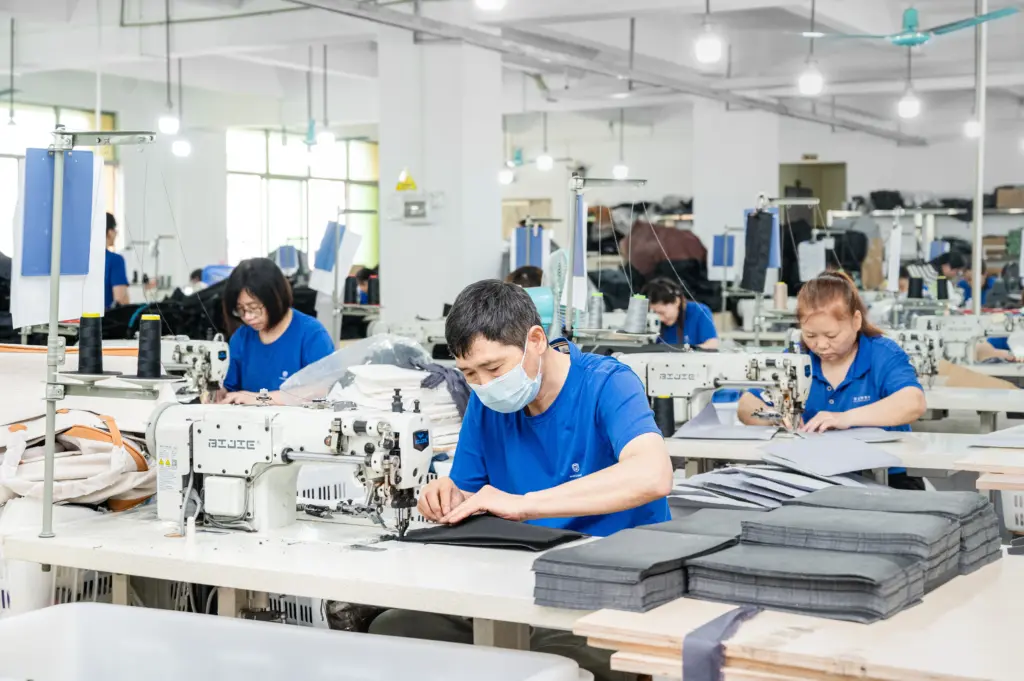
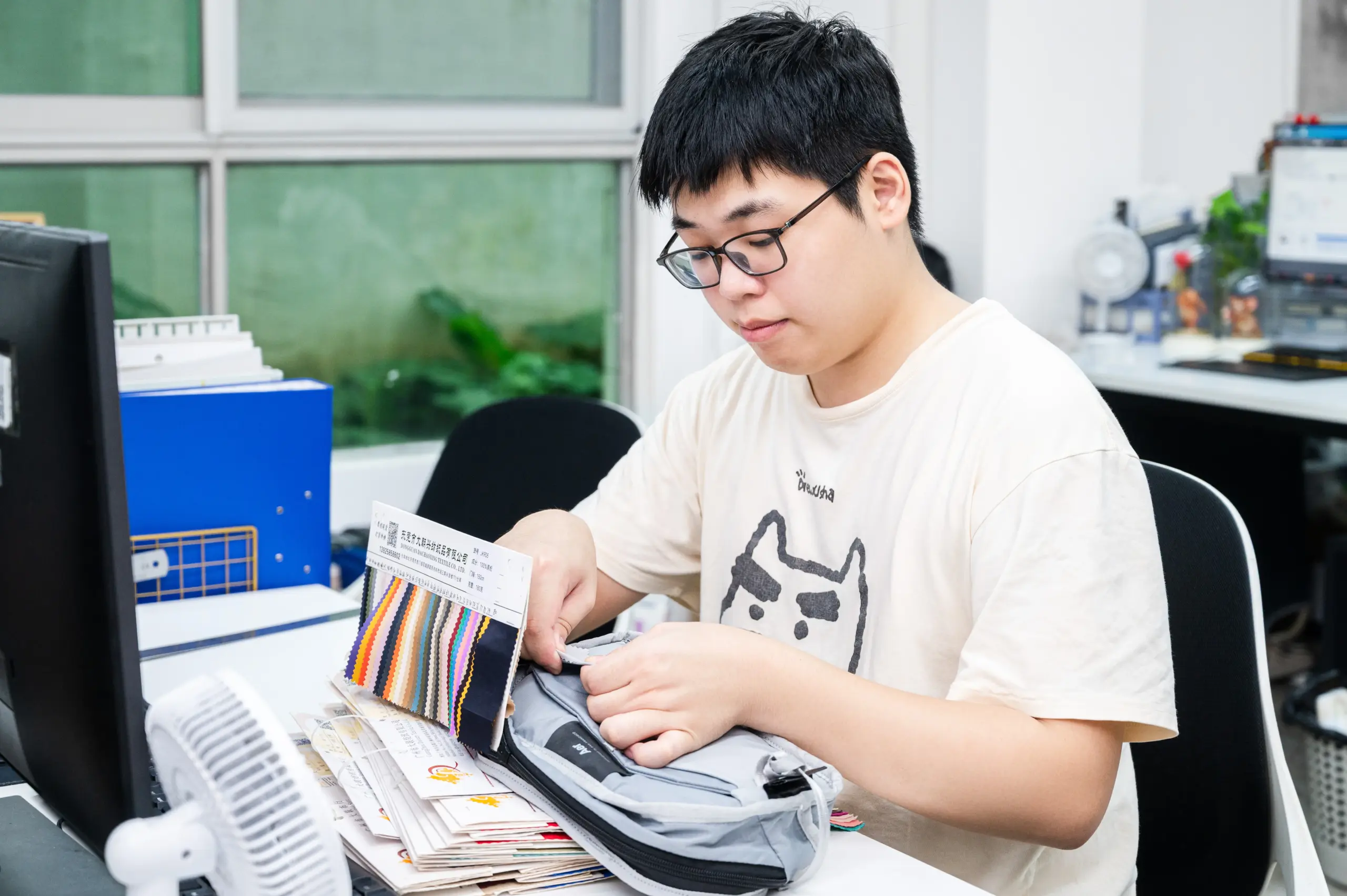
This is the factor most buyers underestimate. The number of individual panels that need to be cut and sewn together is a direct multiplier on your labor cost. A simple tote bag might have 5-6 panels. A technical backpack could have over 20.
A bag with 15 unique panel pieces can easily cost 40% more in labor than a simpler bag with just 8 panels, even if they use the same total amount of material. Why? More time at the automatic cutting tables, more complex sewing line setup, and a higher quality tolerance required at each assembly stage. This is the core of how to calculate bag production cost accurately.
Personnalisation, Printing, and Labeling
Your logo and branding aren’t free. Each customization method has its own cost structure. A multi-color embroidery is priced by stitch count. A screen print is priced by the number of colors and setup screens. A custom-molded metal logo plate involves a one-time mold fee plus the per-unit cost.
These costs are amortized over your production run. This is why a low volume order with complex customization results in a shockingly high per-unit price. It’s not just the bag; it’s the setup cost for every unique detail, spread across too few units.
| Category | Factor | Standard_Option | Premium_Option | Cost_Impact |
|---|---|---|---|---|
| Matériels | Main Body Fabric | Polyester, Toile | GRS Recycled Nylon, Genuine Leather, Cordura® | Prime, sustainable, or branded materials have a significantly higher raw material cost per yard. |
| Matériels | Matériel (Zippers, Buckles) | Standard factory brands (e.g., SBS, SAB) | Top-tier brands (e.g., YKK), custom-molded pulls | Brand reputation, superior durability, and custom tooling for logos on hardware increase component costs. |
| Labor & Complexity | Structural Design | Simple construction (e.g., tote bag with <8 panels) | Complex design (e.g., tech backpack with >15 panels, multiple compartments) | More panels and compartments drastically increase cutting, couture, and assembly time, raising labor costs. |
| Personnalisation | Image de marque & Logo Application | Single-color silk-screen printing | Multi-color embroidery, embossed leather patch, custom metal plate | Complex techniques require more setup, time, and specialized machinery, adding to the per-unit price. |
| Personnalisation | Functional Add-ons | No electronic or special features | Integrated USB port, RFID-blocking pocket, anti-theft lock, waterproof zippers | Each added feature requires extra components, matériels, and specialized labor for installation and testing. |
| Conformité & Quantity | Order Volume (MOQ) | Large volume order (e.g., 1000+ units per style/color) | Low volume order (e.g., 500 unités, the typical minimum) | Smaller orders have higher per-unit costs as fixed setup and material sourcing costs are spread across fewer units. |
How to Get a Lower MOQ or Price
The fastest way to get a “no” from a manufacturer is to ask for a lower price without offering a reason.
Sourcing management experience across dozens of countries indicates that most buyers negotiate completely backward. They focus on the final unit price
Strategies for Negotiating with Your Manufacturer
Forget about trying to squeeze your supplier. Instead, use these strategies to fundamentally change the cost structure of your product. This is how you get a better price a better partnership.
- Attack the Material MOQ, Not the Factory MOQ:The factory’s 500-unit minimum isn’t
- Simplify the Design for Labor Savings: Labor is a huge cost driver. A backpack with 15 unique panel pieces can easily cost 40% more in labor than a simpler bag with 8 panels, even if they use the same amount of material. During the `sample approval` stage, ask your production partner: “If we change this complex curved pocket to a straight-seam design, how much does that reduce the per-unit labor time?” This shows you understand their process and are looking for a mutual win.
- Consolidate Your Bill of Materials (BOM): If you’re launching three different bag styles, don’t spec three different zippers and three different types of webbing. Standardize your components. By using the same black nylon fabric and the same SBS zipper across all three SKUs, you allow the factory to place one large material order. This helps you meet the material supplier’s minimums and gives your factory leverage to negotiate better material pricing, which can then be passed on to your `FOB pricing`.
- Commit to Volume Over Time: If you can’t meet the 500-unit MOQ for a single order, propose a blanket order. Ask the factory: “Can we sign a contract for 1,000 unités, with an initial release of 300 now and the remaining 700 released over the next six months?” This gives the factory the volume commitment they need to procure materials efficiently while allowing you to manage your cash flow and inventory.
Ultimately, the best price goes to the best client. A client with a clear tech pack, realistic quality tolerance expectations, and fast decision-making is more profitable for a factory than a high-maintenance client, even at a slightly lower unit price. Be the partner they want to work with, and you’ll find they are much more flexible on the numbers.
| Strategy | Description | Impact on MOQ | Impact on Price |
|---|---|---|---|
| Opt for In-Stock Models or Materials | Select from the manufacturer’s existing ready-stock designs or use materials they regularly keep in inventory. This bypasses the high MOQs from raw material suppliers. | Significant Reduction. Can lower the typical custom order MOQ of 500+ units down to as low as 200 units for stock items. | Lower. Eliminates custom development costs and leverages the factory’s existing economies of scale on materials and production. |
| Simplify Product Complexity | Reduce the number of unique fabric panels, specialized pockets, and custom hardware. A simpler design requires less cutting and sewing labor time. | Moderate Reduction. A less complex bag reduces production line setup time, making the factory more willing to accept a smaller run. | Significant Reduction. Labor is a key cost driver. A bag with 8 panels can be up to 40% cheaper to produce than a complex 15-panel bag. |
| Consolidate Material Choices Across SKUs | Use the same primary fabric (e.g., black GRS nylon) and hardware (e.g., YKK zippers) across several different bag styles in your total order. | Significant Reduction. Allows for smaller quantities per individual style, as the total material order meets the supplier’s bulk threshold (e.g., 3000 yards). | Lower. Unlocks bulk pricing for the shared material, reducing the per-unit cost for all related SKUs in the order. |
| Commit to a Long-Term Partnership | Negotiate terms based on a forecast of future, recurring orders. Factories prioritize and invest in clients who demonstrate high growth potential and loyalty. | Potential Flexibility. The factory may agree to a lower initial MOQ as a strategic investment in a long-term business relationship. | Lower Over Time. Establishes a partnership that can lead to better pricing, waived fees (e.g., for samples), and other perks on subsequent orders. |
| Standardize Components | Choose high-quality, but standard, components that the factory uses frequently, such as SBS zippers or common types of polyester fabric. | Moderate Reduction. Avoids the need for the factory to place a special, small-batch order for unique components, which often have their own high MOQs. | Lower. The factory gets better pricing on components they buy in massive volumes, and this saving is passed on to you. |
Conclusion
Ignoring the mechanics of bag manufacturing cost is a direct path to margin erosion. A brand that doesn’t understand why a 15-panel bag costs 40% more in labor will accept a quote that eats into their profit for the next 12 months. Failing to question a supplier’s minimum order quantity means you might accept a 1,000-unit order when a 500-unit run was possible, tying up thousands in capital that could have funded your next product launch.
- A factory’s MOQ is often driven by the material supplier’s minimums, not just production capacity.
- Labor costs can increase by 40% or more based on design complexity, like the number of panels.
- Consolidating a single fabric across multiple designs is a proven strategy for negotiating lower order quantities.
- A successful sample approval process requires understanding the cost drivers behind the initial design.
With this framework, you can move beyond simply comparing final FOB pricing. The next step is to analyze your own designs through this lens: can you simplify a panel structure or consolidate materials to improve your unit cost? To see how these principles translate into finished products, review a portfolio of backpack designs to benchmark complexity and features against your own requirements and prepare for a more strategic sourcing conversation.
Foire aux questions
What is the MOQ for a custom bag order?
Our standard minimum order quantity for a fully custom OEM/ODM bag is 500 unités par style. This is often half the typical industry requirement of 1,000 unités. For smaller quantities, consider our in-stock wholesale options, which have an MOQ of 200 unités.
How long does a custom sample take to make?
A custom sample is typically produced within 7 à 10 days after all design specifications are confirmed. This timeline is for production only and does not. Ensure all design files and material choices are finalized to prevent delays in the sampling process.
Are custom samples free?
While our standard in-stock samples are free, custom samples requiring new molds or tooling have an upfront fee. This fee is fully credited back to you or. Always clarify if your design requires a new mold to accurately budget for sampling costs.
Which customizations most affect the bag’s final price?
Material selection and construction complexity are the two biggest factors impacting your per-unit cost. Choosing premium materials like genuine leather or branded hardware from YKK will increase costs more. To manage budget, prioritize essential features and start with more standard, high-quality materials.