A recycled backpack that carries a verifiable chain of custody is a different product — and a different purchase order — from one that simply has “eco” printed on the hangtag. Procurement teams increasingly get caught between the two.
This guide covers what recycled materials actually exist in bag manufacturing, what GRS certification does and does not prove, which document to ask a factory for before you sign anything, and how the material choice changes cost, минимальный заказ, lead time and QC.
Key Takeaways
- Recycled polyester (РПЭТ) and recycled nylon are the two workable shell fabrics for bags; they behave differently, price differently and certify differently.
- A GRS scope certificate proves a factory is audited. A TC (Transaction Certificate) proves your specific shipment contains the recycled content you claimed. Order the TC, not just the logo.
- Under EU Regulation 2024/1781, environmental claims on packaging and textiles sold in Europe must be substantiated — vague “eco-friendly” wording is now a compliance risk, not a marketing preference.
- Recycled shell fabric typically adds a modest premium over virgin equivalents; аппаратное обеспечение, labour and freight dominate landed cost and barely move with the fabric decision.
- Standard custom terms still apply: 500 pieces per style per colour, 7–10 working days for sampling, 30–45 working days for production.
Where Recycled Materials Actually Fit in a Backpack
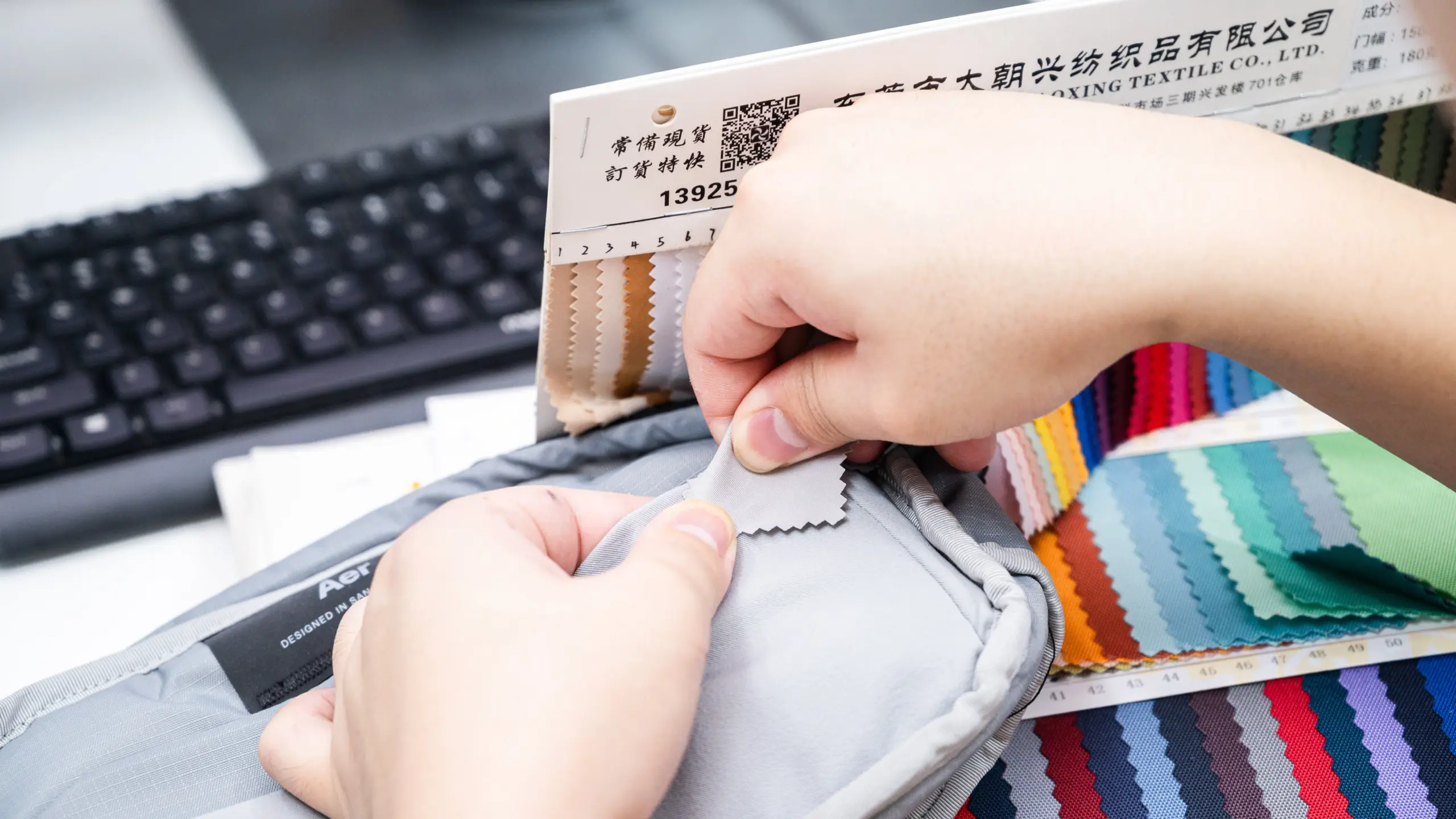
A backpack is not one material. It is a shell fabric, a lining, a foam layer for padding, webbing for straps, zippers and sliders, thread, аппаратное обеспечение, and sometimes a coated or laminated face. Each layer has a different recycling story, and a buyer who specifies “recycled backpack” without naming the layers will receive a quote for something much thinner than they imagined.
The realistic breakdown for a functional bag program:
- Shell fabric — recycled polyester (РПЭТ) and recycled nylon (often regenerated from post-industrial waste) are the mature options, supplied in deniers from roughly 210D to 1680D depending on the use case.
- Оболочка — recycled polyester taffeta is widely available and is often the cheapest place to raise total recycled percentage.
- Strap and back padding — EPE and EVA foams have recycled grades in some supply chains, but availability is batch-dependent; confirm at sampling, not at quotation.
- Webbing, zippers and thread — recycled-content versions exist from major component makers, but they are separate orders with separate minimums. СБС, SAB and YKK zipper lines, for example, are standard on our programs; a recycled zipper pull is a special request, not a default.
- Hardware and coatings — metal buckles and PU/ACR coatings are effectively virgin today. Budget for the claim to be partial, and word it accordingly.
РПЭТ, Recycled Nylon, or Recycled PU
| Материал | Feedstock | Hand Feel & Durability | Where It Works | Claim Risk |
|---|---|---|---|---|
| РПЭТ (recycled polyester) | Post-consumer PET bottles, or post-industrial polyester waste | Close to virgin polyester; slightly more batch-to-batch colour variation | Commuter backpacks, school bags, promotional totes, дорожные сумки | Lowest — the certification path is mature |
| Переработанный нейлон | Regenerated polyamide, largely post-industrial (carpet and offcut streams) | Softer hand, lighter weight, higher abrasion resistance per denier | Premium business backpacks, lightweight travel lines | Moderate — supply is tighter and pricier |
| Переработанный ПУ / coated materials | Bonded or reconstituted PU offcuts | Leather-like face, but lower flex life than a good virgin PU | Trim, accents, low-stress panels | Higher — check recycled percentage and binder content in writing |
For most first programs, RPET shell plus RPET lining is the combination that balances cost, availability and defensibility. Recycled nylon earns its premium where the product is positioned above the mid-market and weight matters. Recycled PU is best treated as an accent story rather than the load-bearing surface of a work bag.
What GRS Certification Proves — and What It Does Not
The Global Recycled Standard, maintained by Textile Exchange, is the certification that buyers and compliance teams ask for by name. Understanding its mechanics prevents the most expensive misunderstanding in this category.
GRS is a voluntary, international standard with four pillars: recycled content, chain of custody, экологический менеджмент, and social and chemical requirements. Two thresholds matter commercially:
- A product needs at least 20% recycled content to be eligible for GRS certification of that material.
- It needs at least 50% recycled content to carry the GRS label on the finished product.
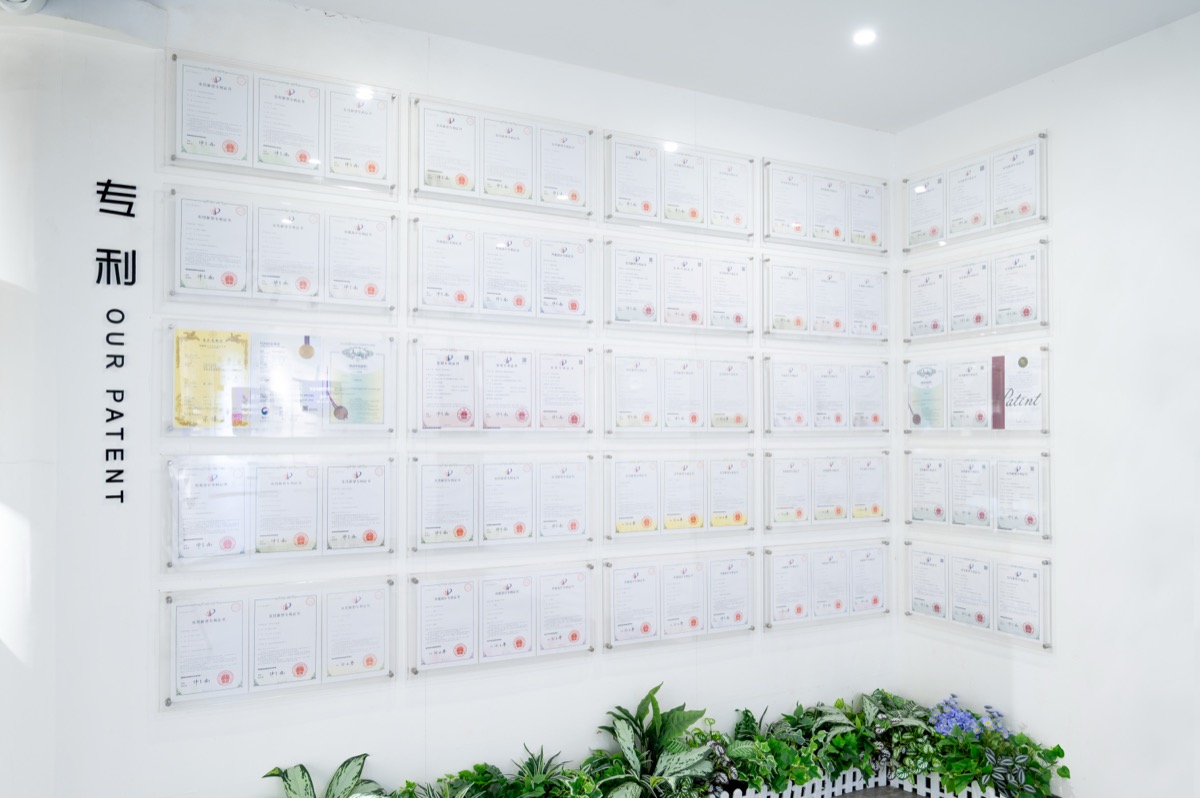
Certification moves through the chain: the recycling facility, the yarn spinner, the fabric mill, the converter, and the final manufacturer each need their own scope certificate, and each needs to buy GRS-certified input from the link above them. If a stage in that chain is uncertified, the claim stops there — no paperwork at the factory can retroactively fix it.
What GRS does not prove: that the bag is 100% переработанный, that it is recyclable at end of life, that it is biodegradable, or that the factory’s carbon footprint is lower by any specific number. It is a content and chain-of-custody standard, not a lifecycle assessment.
The Two Documents to Ask Any Factory For
Ask for these two, in this order, before you approve a sample:
- Scope Certificate (SC). Current, in the name of the legal entity you are contracting with, covering the certified activity (for bags: converting and manufacturing) and the certified standard. Check the certificate body and the validity date. A scope certificate tells you the site is audited.
- Transaction Certificate (TC). Issued per shipment or per order, linking the volume you bought to certified input volume. This is the document your customer’s compliance team actually wants, because it refers to your goods rather than to the factory in general.
A supplier who produces a valid scope certificate but has never issued a TC is telling you something important: they have the certificate and probably not the practice. Ask early whether they can arrange TC issuance through their certification body, and what it costs. The answer usually reveals the maturity of their recycled program in about ninety seconds.
Also request the recycled-content declaration for each fabric in the bill of materials, stating the percentage and which layer it applies to. “Made with recycled materials” without a per-layer percentage is not a specification — it is a slogan.
Reading the Fabric Specification Like a Buyer
Once the certification question is settled, the fabric question is ordinary textile procurement. Denier, weave, weight and coating decide whether the bag survives retail; recycled content does not exempt a fabric from any of it.
- Denier and weave. 210D–300D RPET suits liners and light promotional bags. 600D RPET Oxford is the workhorse for backpack shells. 900D–1680D is for heavy-duty and wheeled applications where abrasion and puncture dominate. Read our full breakdown in the laptop backpack materials guide.
- Coating. PU gives a softer hand; ACR gives better hydrostatic head and a cooler price. Specify the water column in mm if the product claims weather resistance, and test it.
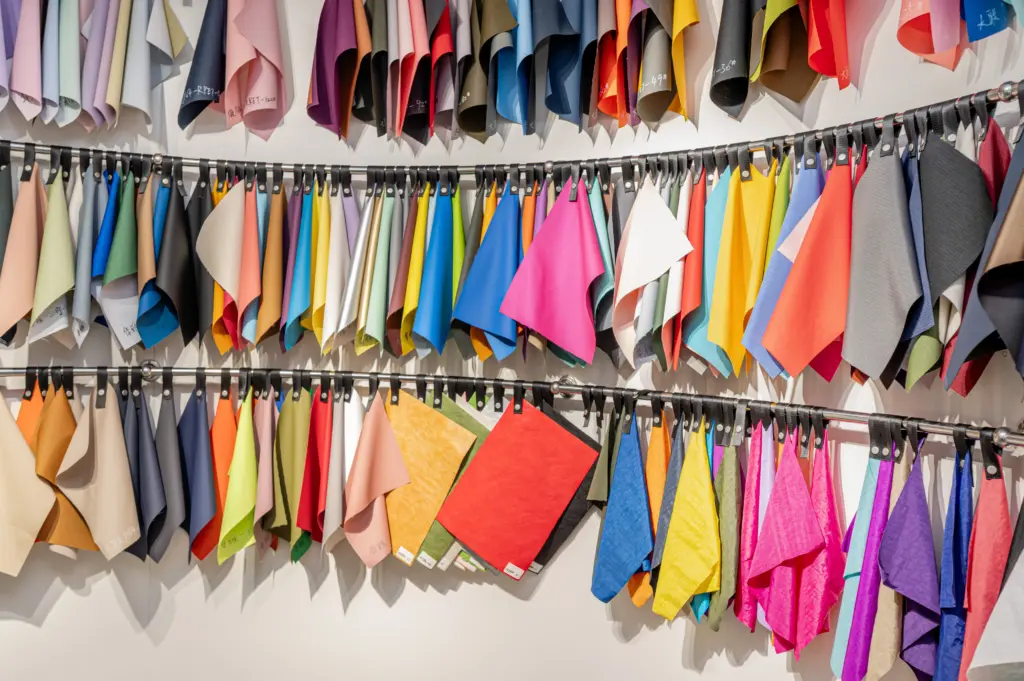
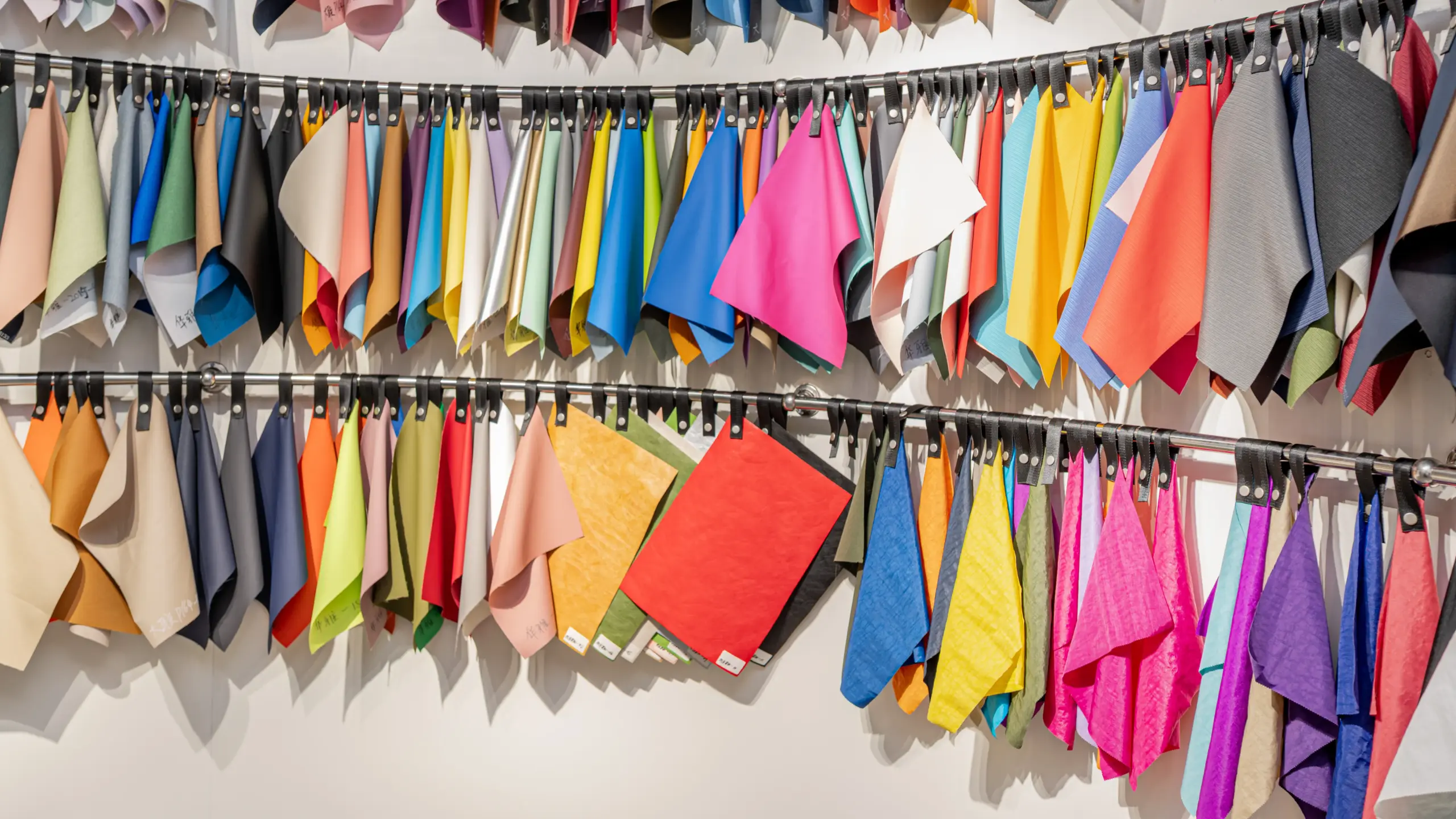
- Стойкость цвета. Solution-dyed recycled yarns hold colour far better than piece-dyed ones and skip a wet-dyeing step, but the colour library is narrower. If your brand runs tight Pantone tolerances, raise this at yarn stage, not at PP sample.
- Batch consistency. Recycled polyester carries more shade variation between lots than virgin. Book the full fabric requirement for a program up front, and keep a documented approved shade standard with a physical witness swatch signed by both sides.
Design Limits Recycled Programs Do Not Announce
Three constraints show up repeatedly once a recycled line moves past the pilot order.
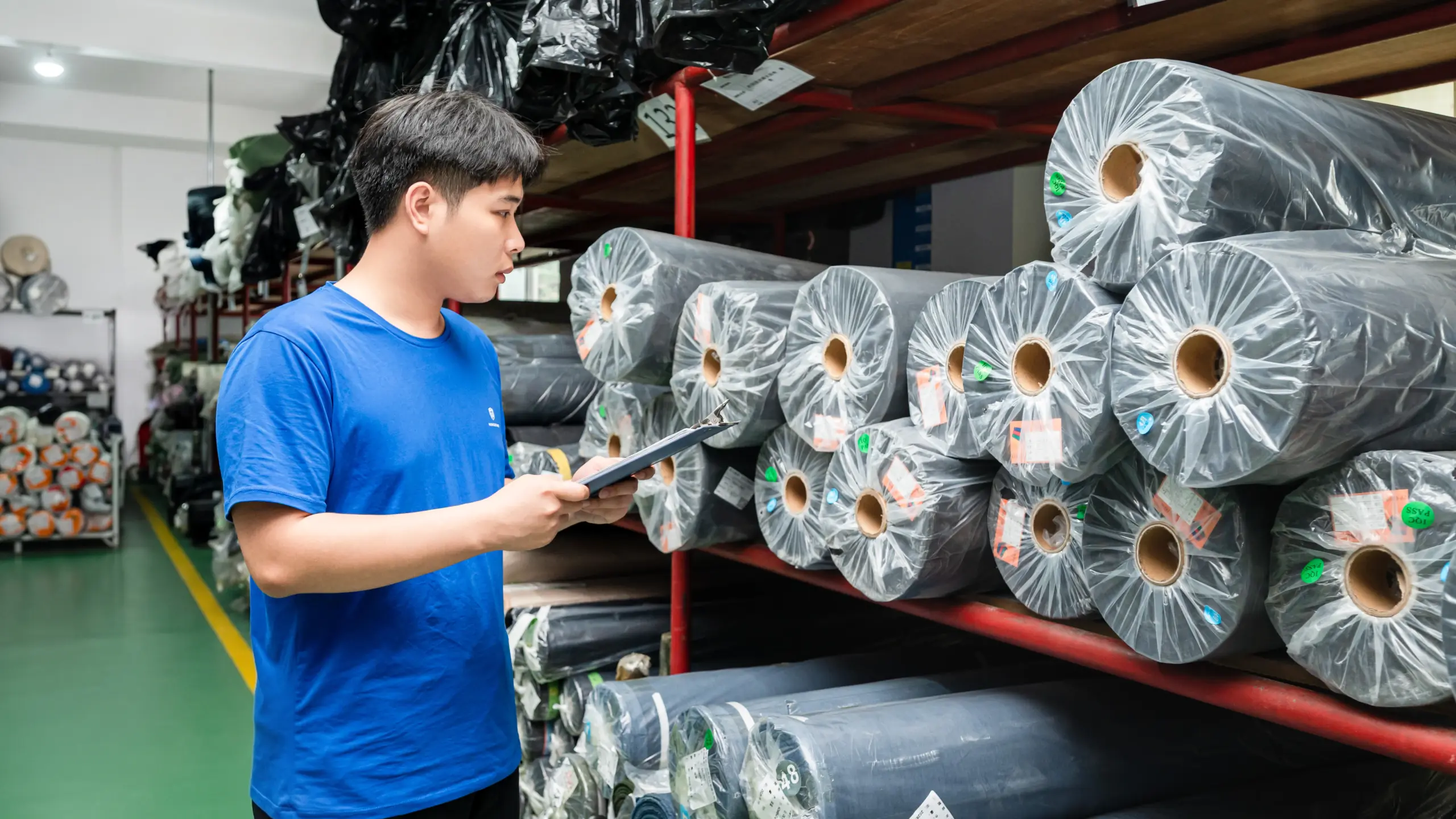
Minimum order quantities are effectively larger. Yarn and greige lots for certified recycled fabric start higher than for stock virgin polyester. On our standard custom terms, a style runs 500 pieces per colour, with trial orders of 200–300 negotiable at an adjusted price. On a certified recycled fabric with a narrow colour library, the practical economics often push toward the upper end of that range, because the mill minimum and the factory minimum have to line up.
Lead time moves, sometimes by weeks. Certified fabric is bought, not pulled off a shelf. Build the fabric order into the schedule rather than assuming the standard 7–10 working day sample and 30–45 working day production window absorbs it. If a line is seasonal, lock the fabric at contract stage.
Some finishes are harder. High-CFM breathable laminates, specialty metallic yarns and certain soft-hand silicone finishes have thinner recycled supply. Ask the mill for a certified alternative with a test swatch before a designer commits to a hand feel.
Cost: Where the Premium Actually Lands
The recycled decision touches a small slice of a landed unit cost. Framed properly, it is a fabric and paperwork question, not a total cost question.
| Cost Line | Effect of Going Recycled | Buyer Action |
|---|---|---|
| Shell fabric | Visible premium, typically mid single-digit to low double-digit percentage over virgin equivalent, varying by denier and dye route | Ask for virgin vs recycled quotes side by side, same construction |
| Оболочка | Small absolute increase; efficient way to lift total recycled percentage | Move lining to RPET before chasing exotic shell fabrics |
| Webbing, молнии, аппаратное обеспечение | Negligible unless you specifically request recycled components with their own minimums | Leave standard unless a claim requires otherwise |
| Certification and TC administration | Fixed handling cost per order; proportionally heavy on small runs | Confirm who carries it before RFQ |
| Labour, оснастка, freight, duty | Unchanged | These still dominate landed cost — see bag manufacturing cost breakdown |
The practical result: a buyer who compares a recycled program against a virgin program only on fabric price will overstate the impact. Compare on landed cost per saleable unit, and the decision becomes straightforward.
КК: recycled Fabric Does Not Lower the Bar
Recycled content is not a substitute for physical testing, and a defect found in a certified fabric still reaches the customer. Our inspection regime for a recycled program is the same 5S-based, three-stage structure used on any production run: incoming material control, in-process checks, and final pre-shipment inspection.
- Incoming: fabric roll inspection against the approved witness swatch, weight and denier verification, water column test on coated goods, and shade-band sorting before cutting.
- In-process: first-article verification at the sewing line, zipper and pull testing, seam strength checks, and dimensional audit against the spec sheet.
- Final: AQL sampling, functional test of every declared feature, and documentation pack assembled with the TC and recycled-content declarations attached.
The testing methods themselves are covered in detail in our quality control and testing guide, and the defect patterns worth pre-empting in the manufacturing defect prevention checklist.

Documentation Pack: What Should Exist at Shipment
| Document | Who Issues It | When | What It Protects You Against |
|---|---|---|---|
| GRS scope certificate (factory) | Accredited certification body | Before contracting | Contracting with an uncertified or trading-only entity |
| Upstream scope certificates (mill, spinner) | Certification bodies along the chain | At fabric booking | A broken chain of custody above your supplier |
| Recycled content declaration, per layer | Fabric mill via the manufacturer | With the PP sample | Claim wording that exceeds the actual bill of materials |
| Transaction Certificate | Certification body, per trade | At shipment | Retail compliance rejection and unverifiable claims |
| Test report (physical and chemical) | Third-party lab | Pre-shipment | Performance claims the fabric cannot support |
Assemble this pack once, as a template, and require it on every repeat order. The second program is where undocumented suppliers drift.
Vendor Vetting: Five Questions That Separate Fact From Marketing
Use these in the first call. The quality of the answers predicts the quality of the program.
- “Show your current GRS scope certificate and tell me which activity it covers.” If the certificate covers trading rather than manufacturing, you are buying from an intermediary.
- “Which of your fabric suppliers are GRS-certified for this construction, and can you buy certified input from them?” This tests whether the chain is real.
- “Have you issued TCs before? For which customers?” Concrete answers, not enthusiasm.
- “What shade standard do you hold, and how do you manage lot-to-lot variation?” A factory without a written procedure will surprise you on order two.
- “What is the minimum recycled fabric booking I must commit to for this style?” This determines whether your MOQ and their mill MOQ fit together.
The wider vetting discipline — audit scope, capacity verification, tooling ownership, communication latency — is set out in our manufacturer vetting checklist, and applies unchanged to sustainable programs.
Common Failure Modes, and How to Price the Risk Out
- Claim inflation. Marketing writes “100% recycled backpack” when the shell is RPET and the rest is virgin. Fix: every public claim traceable to a bill of materials percentage and, where the market requires it, a TC.
- Greenwashing exposure in the EU. Regulation (Евросоюз) 2024/1781 tightens substantiation requirements for environmental claims on products sold in the Union, including packaging. Substantiate before you print, and keep the evidence file for the life of the offer.
- Certified fabric, uncertified factory. A mill scope certificate does not survive a broken chain at the converter. Fix: verify every link named on the declarations.
- Colour drift between reorders. The most common cause of a rejected second batch. Fix: signed witness swatch plus booked dye lot.
- Feature mismatch. A recycled commuter bag sold with a waterproof claim, but the laminate was never specified. Fix: test to the claim, not to the fabric datasheet — and see custom bag materials for how coatings and laminates are chosen in the first place.
When a Recycled Program Makes Commercial Sense
Recycled construction is the right call when at least two of these are true: your target market is EU or North American retail where buyers ask for certification by name; your price point carries the fabric premium without breaking the shelf; the style is going to be reordered, so certification and fabric-booking overhead amortises across volume; and someone on your team owns the documentation file.
It is a poor call as a one-off promotional item, as a first program with an unproven factory, or as a response to a claim your compliance team cannot substantiate. If the objective is a defensible sustainable line rather than a single SKU, start with the standard constructions in our sustainability program, prove the paper trail on one style, then extend.
Часто задаваемые вопросы
Is a recycled backpack less durable than a virgin one?
Not when the fabric is specified to the same construction. Recycled polyester has the same polymer as virgin PET; abrasion resistance, tear strength and coating adhesion are decided by denier, weave density and finish, all of which you specify. The real difference is batch-to-batch shade variation and a narrower colour library, which are managed with a signed witness swatch and booked dye lots.
What is the difference between a GRS scope certificate and a TC?
A scope certificate says a facility is certified for certain activities and materials for a defined period. A Transaction Certificate is issued per trade and links the volume you purchased to certified input. Retail compliance teams generally want the TC, because it refers to your shipment. A factory can hold a valid scope certificate and still be unable to issue TCs if their upstream purchases are not certified.
How much recycled content does a bag need to make a claim?
Under GRS, a material needs 20% or more recycled content to be certified, and a product needs 50% or more to carry the GRS label. Beyond that threshold, the wording of the claim must match the bill of materials — “shell made with 100% recycled polyester” is defensible, “recycled backpack” for a bag with one recycled panel is not. EU Regulation 2024/1781 makes substantiation of environmental claims a legal matter in that market, not a stylistic one.
Does recycled fabric raise MOQ or lead time?
Usually both, modestly. Custom programs run from 500 pieces per style per colour, with 200–300 piece trial orders negotiable at adjusted pricing, but certified mill lots can push the practical colour split higher. On timing, allow the fabric booking inside the normal 7–10 working day sampling and 30–45 working day production windows rather than assuming it absorbs for free — and lock the fabric at contract stage on seasonal lines.
Is recycled nylon worth it over RPET?
When weight, hand feel or abrasion performance per denier is part of the value proposition, yes. Recycled nylon commands a higher price and a tighter supply than RPET, so on a mid-market commuter bag it often buys less than it costs. The common compromise is a recycled nylon shell with recycled polyester lining and virgin webbing and hardware — better weight and feel, with the certification story intact for the visible layer.
Can I get a GRS-certified recycled backpack from Kingsons?
Да. Kingsons holds GRS certification alongside ISO 9001, ИСО 14001, ИСО 45001, Бакалавриат наук, ТРИ, GRS and AEO, and produces RPET and recycled-nylon constructions across business, school, travel and promotional lines. Sampling runs 7–10 working days, production 30–45 working days, with per-layer recycled content declared in the bill of materials. Start from the sustainability program with your target retail price and certification requirement, and we will quote virgin and recycled constructions side by side.
Source a GRS-certified recycled line with the paperwork to prove it.