
Security is the feature cluster that travel and commuter bag buyers actually research before purchasing — and the one most private-label programs under-spec. An anti-theft backpack is not one feature but a stack: where the openings sit, how the zippers resist tampering, what locks down, what blocks wireless skimming, and what survives a blade. This guide breaks down the five security features with proven sell-through, the engineering behind each, and how brands should combine them into tiered lines — written for the buyers who commission them.
الوجبات السريعة الرئيسية
- Five security features drive anti-theft sell-through: hidden rear-panel entry, anti-theft zipper systems, أجهزة القفل (including TSA locks), RFID-blocking pockets, and cut-resistant panels and straps.
- The features stack into natural price tiers — entry lines pair hidden pockets with lockable zippers; premium lines add RFID shielding and cut-resistant construction.
- Zipper and hardware choices carry the security load: Kingsons specs SBS, SAB and YKK zippers with double-layer explosion-proof construction in its published anti-theft designs.
- Kingsons’ one-chain-molded anti-theft backpack was validated with a $1.22M Kickstarter campaign — proof that security-led designs can carry a premium positioning at retail.
- Custom security programs run at standard MOQ 500 pieces per style per color; sampling 7–10 working days, mass production 30–45 working days.
Why Security Features Sell Travel and Commuter Bags
Every travel-brand merchandiser knows the pattern: a customer lands on a product page for capacity or style, then scrolls straight to “is it secure?” Urban commuting through crowded transit, tourist-district exposure, overnight flights — these are theft-anxiety contexts, and bags that answer the anxiety convert better and justify higher price points. Search behavior mirrors it: anti theft backpack queries run in the thousands monthly, concentrated on travel and commuter use rather than any single product niche.
For brands, the strategic value is differentiation that competitors cannot copy with a colorway. A security stack is engineering — panel geometry, zipper construction, hardware selection — protected by patents and validated by testing. Kingsons has built its functional-bag position on exactly this logic: anti-theft construction sits alongside shockproof, radiation-shielding and charging technologies within a portfolio of 500+ self-developed patents, and the company’s one-chain-molded anti-theft backpack completed a $1.22M Kickstarter campaign before entering volume production.
ميزة 1: Hidden Rear-Panel Entry
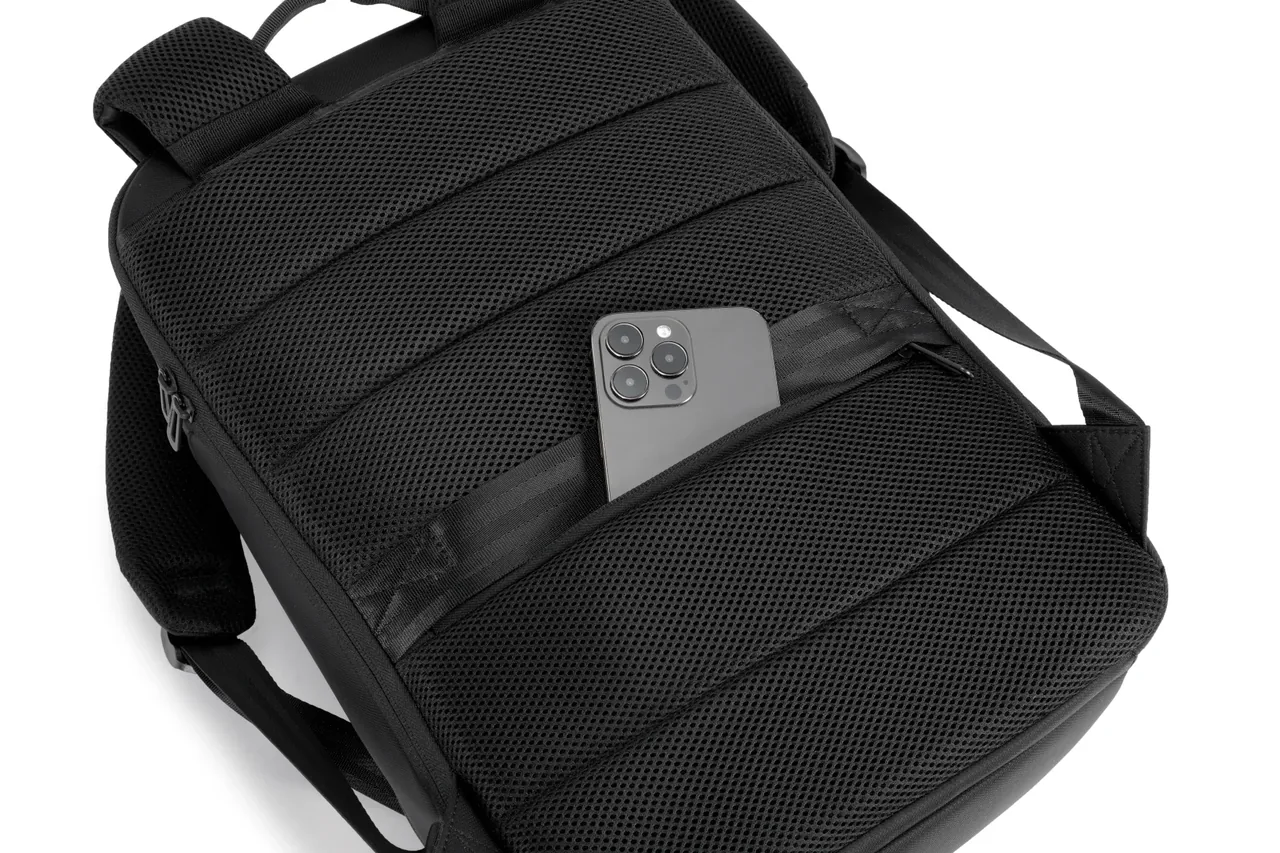
The single most effective anti-pickpocket design move costs almost nothing in materials: move the main opening to the panel that rests against the wearer’s back. A thief cannot open what they cannot reach, and the rear panel is the one surface a wearer’s body guards continuously.
Design execution matters more than the concept:
- Full rear entry versus hidden pocket. Full rear-entry designs swing the entire back panel open for both security and a flat packing surface; lighter versions keep a conventional opening and add a hidden rear pocket for passports and cards.
- Quick-access balance. If everything is hidden, daily usability suffers. The strongest commuter designs pair the secure rear compartment with one quick-access pocket for transit cards — placed where the wearer’s hand naturally shields it.
- بناء. Rear-entry panels need firm padding and shape retention so the opening does not gape with wear; spec foam density and panel reinforcement in the tech pack.
ميزة 2: Anti-Theft Zipper Systems
Zippers are how bags are actually opened — by owners and by thieves. Anti-theft zipper engineering attacks three weaknesses: visibility, accessibility and forced entry.
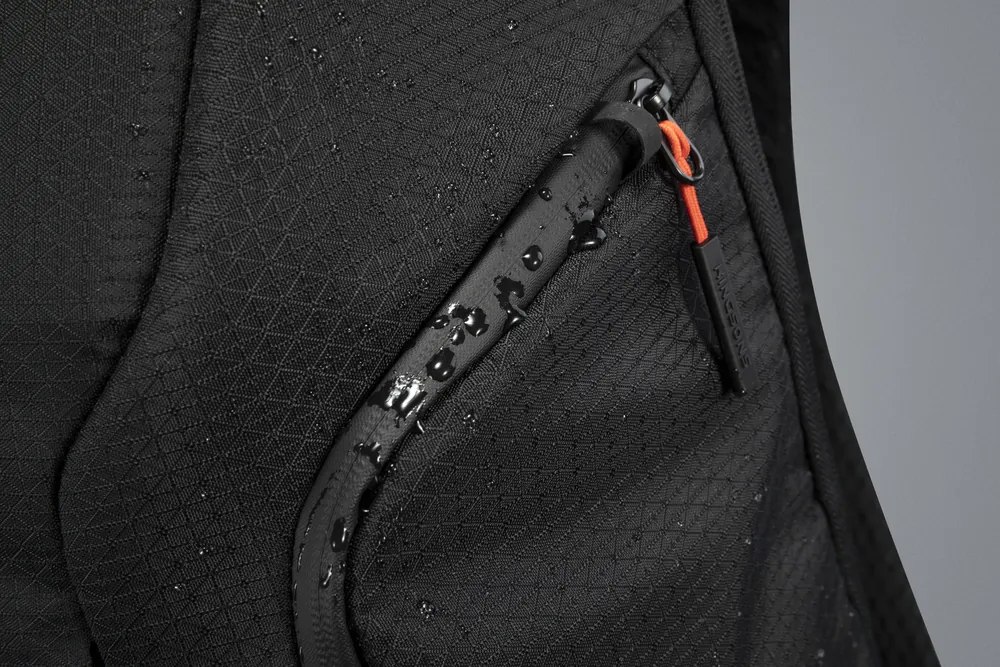
- Concealed zippers. Reverse-mounted or fabric-shrouded tracks hide the slider from casual view; the opening disappears into the silhouette.
- One-chain-molded construction. Kingsons’ patented one-chain-molded design integrates the zipper chain into the bag structure so the opening cannot be peeled apart at the corners — the construction behind its crowdfunded flagship.
- Double-layer explosion-proof zippers. Published Kingsons specifications describe double-layer explosion-proof zipper systems that resist puncture and forced insertion of tools — the defense against the classic ballpoint-pen attack on ordinary coils.
- Brand and spec discipline. Security zippers are specified from proven suppliers — Kingsons sources from SBS, SAB and YKK — because a security claim built on an unproven zipper is a warranty and reputation liability.
For sourcing teams, the test is blunt: ask how the sample’s main zipper resists a pen tip and a firm peel at both ends, and ask to see the answer in the QC protocol. Zipper reciprocation-cycle testing confirms durability on top of tamper resistance — a checkpoint covered in our guide to manufacturing defect prevention.
ميزة 3: Locking Hardware That Actually Deters
Locks convert a soft bag into an anchor point and a delay mechanism. Three formats dominate travel and commuter lines:

- TSA combination locks secure zipper pulls to a fixed point; the TSA-accessible keyway means inspections do not destroy the lock. Essential for any checked or gate-checked travel line.
- Lockable zipper garages and dual-slider pulls. Two sliders meeting on one track, locked together, remove the grab-and-yank attack surface entirely on commuter bags.
- Cable and anchor systems. Retractable cables let the wearer lock the bag to café chairs, luggage racks and train posts — high perceived value for the travel-retail shelf.
Hardware sourcing is a place where quality gaps hide. Lock mechanisms cycle dozens of times daily in commuter use; specify salt-spray-tested, cycle-tested hardware from established suppliers (Kingsons’ hardware partners include SFS and ITW, with hand-plated, hand-polished finishes) rather than accepting whatever the sample room shows. For the laptop-specific angle — locking a mobile office rather than luggage — our companion piece on anti-theft laptop backpack sourcing covers device-security additions in depth.
ميزة 4: RFID-Blocking Pockets
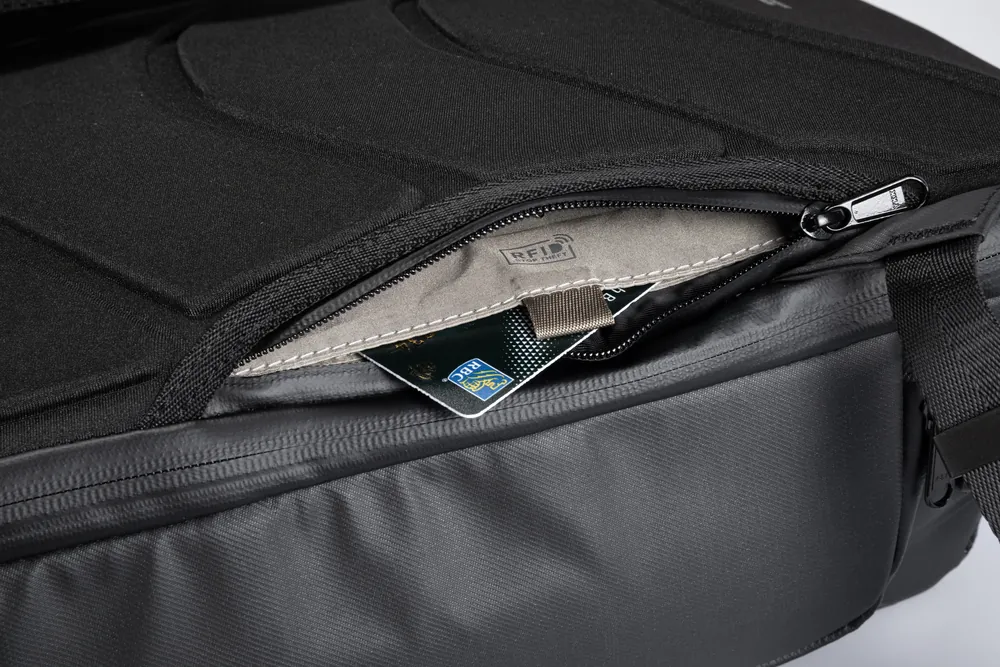
Not every thief opens the bag. Contactless skimming reads payment cards and passports through fabric, which makes RFID shielding the security feature that protects data rather than property — and the easiest one to demonstrate in marketing, because the pocket works invisibly and constantly.
Execution notes for brand programs:
- Placement and labeling. One clearly-labeled pocket near the top of the organizer converts better than unlabeled shielding scattered through the lining; users need to know where their protected zone is.
- مواصفة. Kingsons’ published specifications describe RFID shielding at up to 99.99% in its anti-theft line; when you commission your own, tie the shielding fabric spec and test evidence to the bill of materials so the claim is defensible.
- Scope honestly. RFID pockets block card frequencies; they are not broadband signal shielding. Brands that want the full-enclosure version — cellular, Wi-Fi, GPS — should spec a faraday-tier product, which our guide to faraday bag manufacturing covers in detail.
ميزة 5: Cut-Resistant Panels and Straps
The violent end of the threat model: a blade across the panel or a slash-and-grab through a strap. Cut resistance is layered into the bag’s structure rather than applied as an accessory.
- Slash-resistant panel layers. Kingsons’ published anti-theft technology set includes cut-resistant construction laminated into vulnerable panels, so a slit does not open the compartment.
- Reinforced strap cores. Straps carry the load and the grab; high-tenacity webbing and layered attachment points resist a single violent pull or cut.
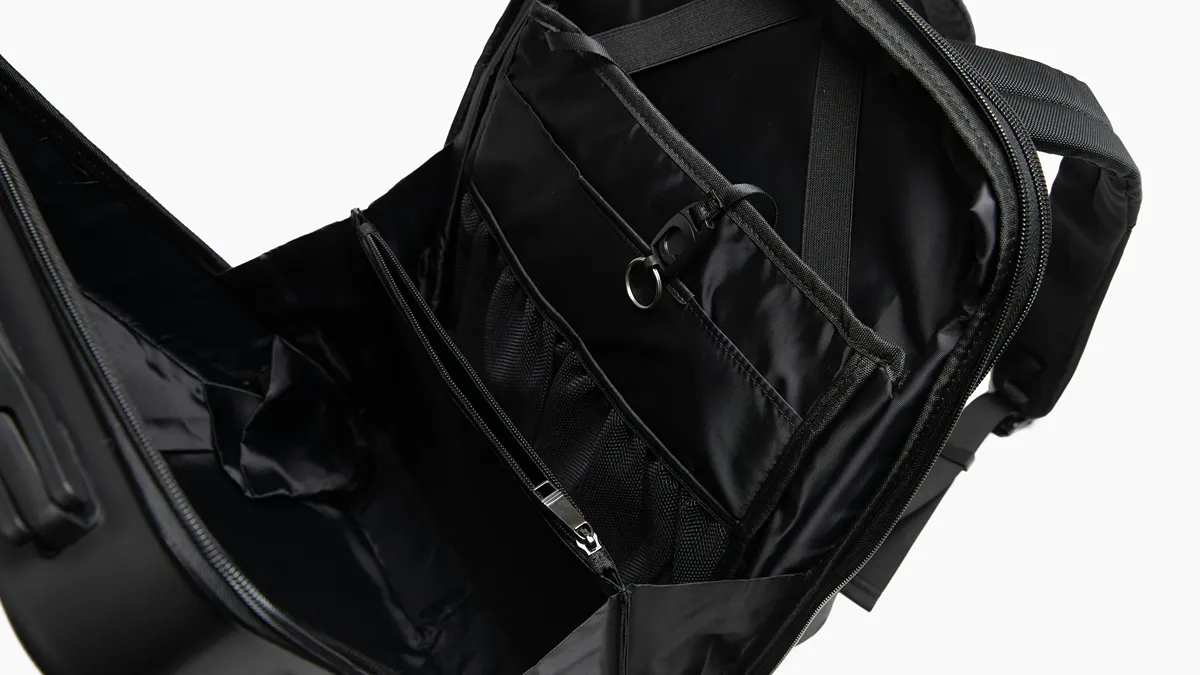
- Hidden valuables architecture. Cut resistance works best combined with compartment discipline — valuables seated in interior pockets away from every exterior wall, so even a successful slash reaches fabric, not passports.
Weight and hand feel are the trade-offs to manage: cut-resistant laminates add grams and stiffness. Sample against your price tier’s wearability target, not just its attack scenarios.
Stacking the Five: Security Tiers That Map to Price Points
The five features are modular, and the strongest anti-theft ranges ladder them deliberately rather than offering one maximum-spec bag.
| Tier | Feature Stack | Positioning | Typical Retailer |
|---|---|---|---|
| Entry commuter | Hidden rear pocket + lockable dual-slider zippers | Everyday reassurance at accessible price | Mass retail, online marketplaces |
| Travel core | Rear entry + concealed zippers + قفل TSA | Weekend and flight use | Travel specialty, department stores |
| Premium security | Full stack + جيب RFID + ألواح مقاومة للقطع | Urban and international travel flagship | Premium travel, security-focused retail |
| Tech flagship | Full stack + device protection (shockproof laptop bay, الشحن) | Smart tech positioning | Tech retail, brand D2C |
One platform can usually serve three tiers with shared patterns — the hidden pocket sewn shut on entry SKUs, the RFID liner added on premium ones. That keeps tooling costs amortized while giving merchandisers a story ladder. For the broader mechanics of configuring features on a base design, see backpack customization options, and for taking a travel line to market without full custom development, travel backpack wholesale and private label programs.
Testing Security Claims Before They Ship
Every feature above is also a claim your customer service team will inherit. Verify at sample and production stages:
- Zipper forced-entry trials on finished samples — pen-tip puncture and corner peel, repeated across the run’s zipper lots.
- Lock cycle and corrosion testing — combination mechanisms cycled to spec, hardware salt-sprayed for corrosion resistance.
- RFID shielding verification with test cards against the specified pocket, per production batch.
- Strap and seam tensile tests — the same battery that protects any premium bag, documented per order.
A factory running full-process QC with its own test equipment — Kingsons operates tensile, ضد للماء, zipper-reciprocation and material performance labs inside its inspection workflow — can attach these results to your order rather than describing them in general terms. The complete testing picture is laid out in our quality control testing guide.
موك, Customization and Lead Times for Security Lines
Security programs price like any custom soft-goods line, with feature stack driving cost and complexity:
| Program Scope | Standard MOQ | Trial Order | Sample Time | إنتاج |
|---|---|---|---|---|
| Security features on a catalog base model | 500 جهاز كمبيوتر شخصى / style / لون | 200–300 pcs | 7–10 working days | 30–40 days |
| Full feature-stack configuration (Tier 3) | 500 جهاز كمبيوتر شخصى / style | 200–300 pcs | 10–15 working days | 35–45 days |
| Bespoke security platform (new pattern) | 500–1,000 pcs | Negotiable | 15–20+ working days | 40– 50 يومًا |
| Logo-only on branded stock security model | 200 جهاز كمبيوتر شخصى | — | 5–7 working days | 25–30 days |
Practical notes: TSA locks and cable hardware are sourced components with their own lead times — confirm availability at quotation, not after sampling. Cut-resistant laminates and shielding fabrics should be locked by specification with the supplier named, exactly like a Pantone dye. And if your program blends security with device protection or charging, fold the additional assembly steps into the timeline rather than discovering them at pre-production.
Positioning the Five Features in Your Marketing
Security features sell when they are named, demonstrated and tiered. Three practices that consistently outperform:
- Lead with the scenario, prove with the feature. “Opens against your back” outperforms “hidden zipper” in copy; the feature name then anchors the claim.
- Demonstrate the stack visually. Exploded diagrams and cutaway photography of the five features convert research-stage buyers; commission this content with the sample round, while prototypes are on hand.
- Tier the badge. A named security system that appears across your range (with tier levels) builds an ownable asset — the approach behind Kingsons’ ClickPack flagship line and its one-chain-molded construction story.
Sourcing Checklist for an Anti-Theft Program
- Target market and theft context (urban commute, international travel, event crowds) — it decides the feature stack.
- Tier plan: which features on which SKUs, and which platform they share.
- Zipper construction and supplier spec; الأجهزة (قفل TSA, sliders, cable) selection.
- RFID pocket spec and verification method; cut-resistant layer scope and weight budget.
- Compliance documents for target markets and the QC protocol in writing.
- In-hand date worked backward through sampling, component sourcing and 30–45 day production.
Bring those six items to a manufacturer with security-bag engineering heritage, and the conversation moves from “can you add a hidden pocket” to a production plan.
الأسئلة المتداولة
What makes a backpack anti-theft?
A stack of design features that remove theft opportunities: openings moved to the wearer’s back, concealed or one-chain-molded zippers that resist peeling and puncture, lockable hardware including TSA locks, RFID-shielded pockets against card skimming, and cut-resistant panel and strap layers. No single feature makes a bag anti-theft — the stack does.
Do anti-theft backpacks actually work?
Yes — they work by delay and denial rather than invulnerability. A thief cannot reach a rear-panel opening, cannot quietly open a concealed locked zipper, and cannot quickly slash a reinforced panel. Security features shift risk to easier targets, which is exactly how theft prevention functions in practice. Validate any product you commission with forced-entry trials on finished samples.
What is the MOQ for a custom anti-theft backpack?
Standard custom MOQ is 500 pieces per style per color, with trial orders of 200–300 pieces negotiable at an adjusted price. Logo-only runs on a branded stock security model start at 200 pieces, and small flexible batches from 50 pieces are available for pilots and events.
Do I need a TSA lock on a commuter backpack?
For daily commuting, lockable dual-slider zippers usually suffice — the threat is pickpocketing, not inspection. TSA-approved combination locks earn their cost on travel lines that get gate-checked, stowed in overhead bins or checked as luggage, since security screening can open and relock the bag without cutting anything. Most tiered ranges fit TSA locks from the travel tier upward.
How do I verify an RFID-blocking pocket?
Test with a contactless card or RFID test card inside the pocket against a reader — a functional check any buyer can run on a sample. For production, require verification per batch and tie the shielding fabric specification, with supplier named, to the bill of materials so the claim stays defensible at scale.
How long does a custom security backpack program take?
Feature-stack programs on a base model sample in 10–15 working days and produce in 35–45 days; bespoke platforms run 15–20+ day sampling and 40–50 day production. Component sourcing — TSA locks, shielding fabric, cut-resistant laminate — should be confirmed at quotation to protect the timeline.
Kingsons engineers anti-theft construction backed by 500+ patents — one-chain-molded zippers, double-layer explosion-proof closure, TSA locks and RFID shielding up to 99.99% — on a 50,000 m² campus producing 300,000 وحدات شهريا.
موك من 500 pcs/style · Crowdfunded security flagship heritage · SBS/SAB/YKK zippers · Full-process QC with security feature testing