By Kingsons Editorial Team · Published August 22, 2026
A single failed zipper can cost a backpack brand thousands of dollars in returns, críticas negativas, and lost retail shelf space. For B2B buyers sourcing laptop backpacks from manufacturers, quality control is not a nice-to-have — it is the difference between a product that builds your reputation and one that destroys it. Yet most buyers enter production with nothing more than a verbal assurance that “we have strict QC.”
This guide breaks down the exact testing standards, parameters, and equipment used in laptop backpack quality control at a Guangzhou-based factory that produces 300,000 units monthly across 20 production lines. Every benchmark cited here — from the 800-newton seam strength threshold to the 12,000-cycle zipper test — comes from active production data, not textbook theory. If your current supplier cannot quote these numbers from memory, you have work to do.
Conclusiones clave
- Laptop backpack QC operates on three stages: incoming quality control (IQC), in-process inspection (IPQC), and final random inspection (FRI) — skipping any stage leaves a gap where defects escape.
- Seam strength must hold a minimum 800N pull force on all load-bearing seams; anything below 600N will split under daily laptop carry within months.
- Zipper durability requires 12,000 open-close cycles on a reciprocating tester — simulating roughly two years of daily use at 15 cycles per day.
- Water resistance testing uses a 1,000mm water column for standard claims and 3,000mm+ for “waterproof” positioning.
- A qualified factory owns its own testing lab with a universal tensile machine, waterproofness tester, zipper reciprocating tester, and Martindale abrasion machine — outsourcing every test to third-party labs signals weak in-process control.
The Three Stages of Laptop Backpack Quality Control
Quality control in laptop backpack manufacturing is not a single checkpoint at the end of the production line. It is a three-stage system that catches defects at the point they occur, when they are cheapest to fix. Factories that only inspect finished goods are finding problems after the cost of correction has multiplied tenfold.
Escenario 1: Incoming Quality Control (IQC)
IQC happens before production starts. Every batch of fabric, zipper, buckle, foam, and thread is tested against specifications before it enters the workshop. At a qualified laptop backpack factory, this means checking fabric weight (denier count), color fastness (grade 4 minimum on the gray scale), zipper smoothness across 50 sample pulls, and foam density (25 kg/m³ minimum for laptop compartments).
The cost of catching a defective fabric roll at IQC is the price of returning it to the supplier — perhaps a few hundred dollars in logistics. The cost of catching that same defect after 5,000 backpacks have been cut and sewn is the price of 5,000 units of wasted labor, plus the delay of re-ordering correct fabric. The ratio is roughly 1:50.
Escenario 2: In-Process Quality Control (IPQC)
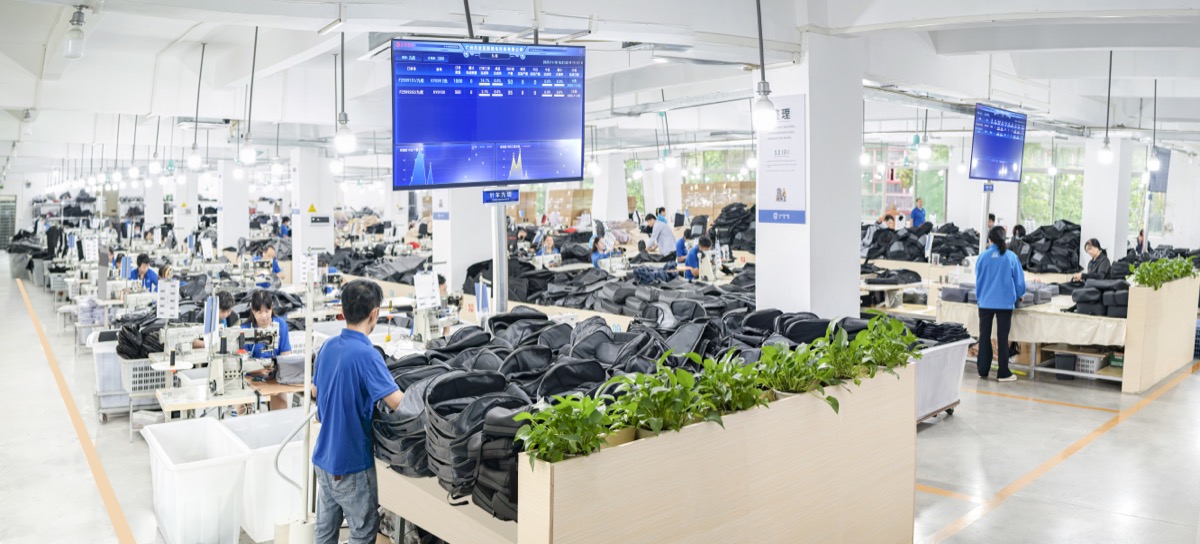
IPQC runs during production. Inspectors walk the sewing lines at scheduled intervals, pulling random units at each workstation to check stitch density (8–10 stitches per inch on load-bearing seams), seam alignment, foam placement, and zipper installation. This stage catches the drift that happens when operators rush through lunch-break backlogs or when a machine needle dulls mid-shift.
A well-run IPQC system records every finding in a production quality log. If the defect rate on a specific seam crosses 2%, the line stops for a root cause analysis. At a factory producing 300,000 laptop backpacks per month, even a 1% defect rate means 3,000 units — enough to fill a shipping container with products that need rework.
Escenario 3: Final Random Inspection (FRI)
FRI is the last gate before packaging. Using the ANSI/ASQ Z1.4 sampling standard (or its ISO 2859-1 equivalent), inspectors pull a random sample from each production lot and run the full test battery: visual inspection, dimensional check, function test, seam strength, zipper reciprocating, and load-bearing. The acceptance quality limit (AQL) for laptop backpacks is typically set at 2.5 for major defects and 4.0 for minor defects.
| QC Stage | When | What Is Checked | Cost of Catching a Defect |
|---|---|---|---|
| IQC | Before production | Fabric weight, color fastness, zipper smoothness, foam density, hardware finish | $ (return to supplier) |
| IPQC | During production | Stitch density, seam alignment, foam placement, zipper installation, operator technique | $$ (rework at line) |
| FRI | Before packaging | Full test battery: visual, dimensional, functional, seam strength, zipper cycles, load | $$$ (sort/packhold/reshiip) |
Five Critical Tests Every Laptop Backpack Must Pass
These are the specific benchmarks that separate a qualified laptop backpack manufacturer from one that is guessing. Each test simulates a real-world failure mode. If your supplier does not run all five, your product is going to market with blind spots.
Prueba 1: Seam Strength (Mínimo 800N)
The seam is the weakest point on any backpack. When a laptop backpack fails in the field — splitting at the shoulder strap attachment, tearing at the bottom panel, or opening along the laptop compartment zipper — it is almost always a seam failure, not a fabric failure.
The test uses a universal tensile testing machine. A sample seam is clamped on both sides and pulled apart at a controlled rate. The minimum acceptable strength for load-bearing seams on a laptop backpack is 800 newtons. Below 600N, the seam will likely split under normal laptop weight (1.5–2.5 kg) within months of daily carry. Between 600N and 800N, the seam holds initially but degrades under cyclical loading — the kind of fatigue that causes failures at the six-month mark rather than on day one.
En Kingson, every new seam configuration is tested during sampling, and random production units are pulled weekly for verification. The 800N threshold is written into the production specification sheet that travels with every order.
Prueba 2: Zipper Reciprocating (12,000 Cycles)
The zipper is the most failure-prone component on any backpack. A laptop backpack typically has three to six zippers, each opened and closed multiple times per day. Over two years of daily use at an average of 15 cycles per day, a single zipper accumulates roughly 10,000 open-close operations.
The test mounts the zipper on a reciprocating tester that pulls it open and closed at a consistent speed. The pass threshold is 12,000 cycles without tooth separation, slider derailment, or excessive wear. This provides a safety margin above the expected two-year usage cycle.
The difference between a branded zipper (YKK, SBS) and a no-name alternative shows up clearly in this test. A YKK #8 coil zipper — the standard for laptop backpack main compartments — consistently exceeds 15,000 ciclos. A no-name zipper of the same gauge may fail at 4,000–6,000 cycles. The per-unit cost difference is $0.30–$0.80. The cost of a field failure — measured in returns, críticas negativas, and brand damage — runs 10–50x that amount.
A buyer once received a sample batch where all zippers passed — but the factory swapped to a cheaper zipper supplier for mass production without notification. The batch of 8,000 units failed at 4,000 cycles instead of 12,000. The only protection: a contractual specification sheet naming the exact zipper brand and model, with penalties for unauthorized substitution.
Prueba 3: Water Resistance (1,000mm–3,000mm Water Column)
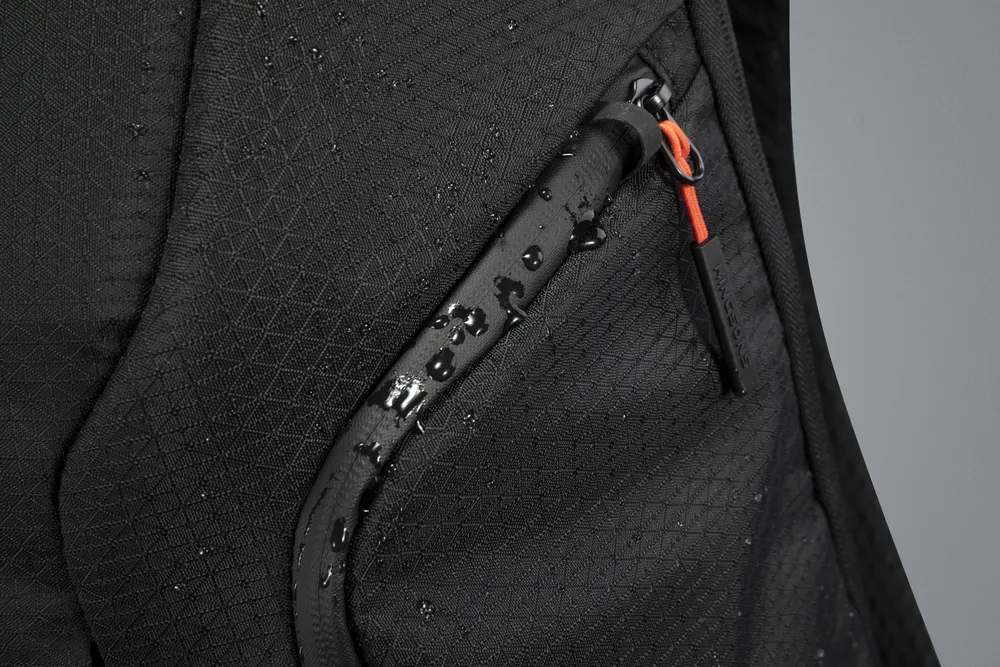
Laptop backpacks carry electronics worth hundreds or thousands of dollars. Water resistance is not a luxury feature — it is a baseline expectation. The test presses a column of water against the fabric surface and measures how long it takes for moisture to penetrate.
| Claim Level | Water Column | Duration | Typical Use Case |
|---|---|---|---|
| Water-resistant | 1,000milímetros | 24 horas, no penetration | Daily commute, light rain |
| Impermeable (estándar) | 3,000milímetros | 24 horas, no penetration | Outdoor use, heavy rain |
| Impermeable (heavy-duty) | 5,000mm+ | 24 horas, no penetration | Extreme weather, submersion risk |
For most B2B laptop backpack orders, the 1,000mm standard is sufficient. It protects against rain splashes and brief exposure. If your product is positioned for outdoor or travel use, specify 3,000mm. The cost difference is typically a PU coating upgrade or a TPU lamination layer, adding $0.50–$1.50 per unit.
Prueba 4: Load-Bearing (125% Rated Capacity, 24 Hours)
A laptop backpack is rated for a maximum load — typically 8–12 kg depending on the model. The load-bearing test hangs 125% of the rated capacity from the backpack for 24 continuous hours. After removal, the straps, manijas, attachment points, and frame must show no deformation beyond 2%.
This test catches two failure modes. First: structural deformation that develops under sustained load — straps stretching, buckles warping, attachment points pulling away from the body panel. Second: material creep in the foam and padding that reduces comfort over time. A backpack that feels comfortable on day one but develops strap sag by month three has failed this test.
Prueba 5: Abrasion Resistance (5,000 Cycles, Calificación 4 Minimum)
The fabric surface of a laptop backpack rubs against desks, chair backs, car seats, and airport flooring thousands of times over its lifespan. The abrasion test uses a Martindale machine to rub the fabric surface against a standardized abrasive pad for 5,000 ciclos. After testing, the color fading must not exceed grade 4 on the ISO gray scale — meaning the color change must be barely perceptible to the human eye.
This test matters most for light-colored fabrics and printed surfaces. A dark navy 600D polyester typically passes easily. A light gray RPET recycled fabric or a silk-screened logo surface may fail if the dye or ink adhesion is poor. Catching this at the IQC stage prevents an entire production batch from shipping with a cosmetic defect that only appears after months of use.
In-House Testing Lab vs Third-Party Outsourcing
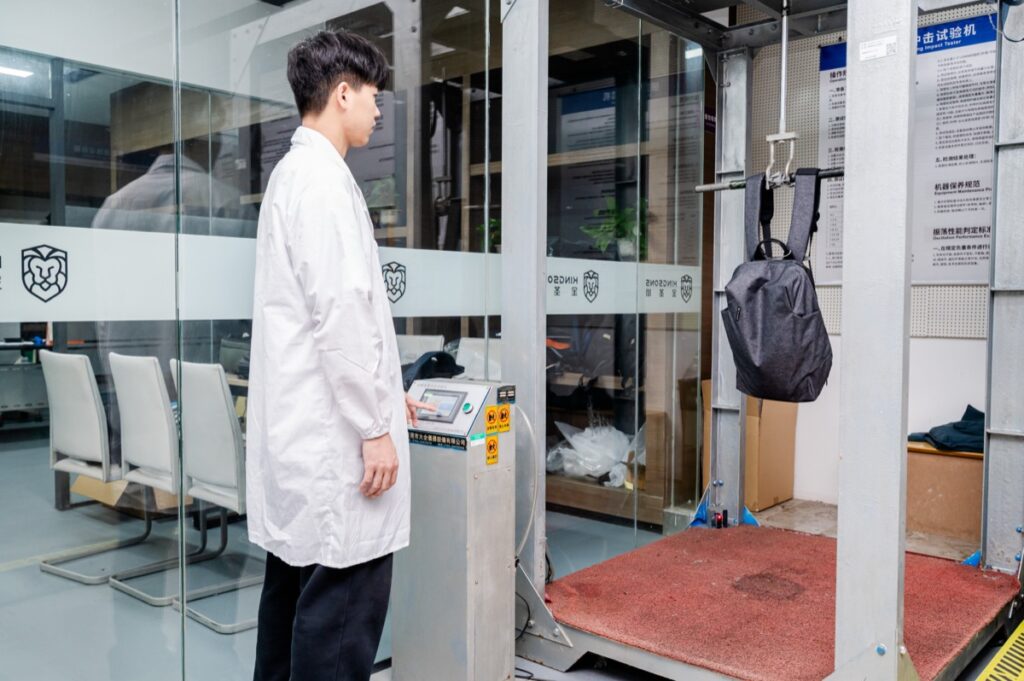
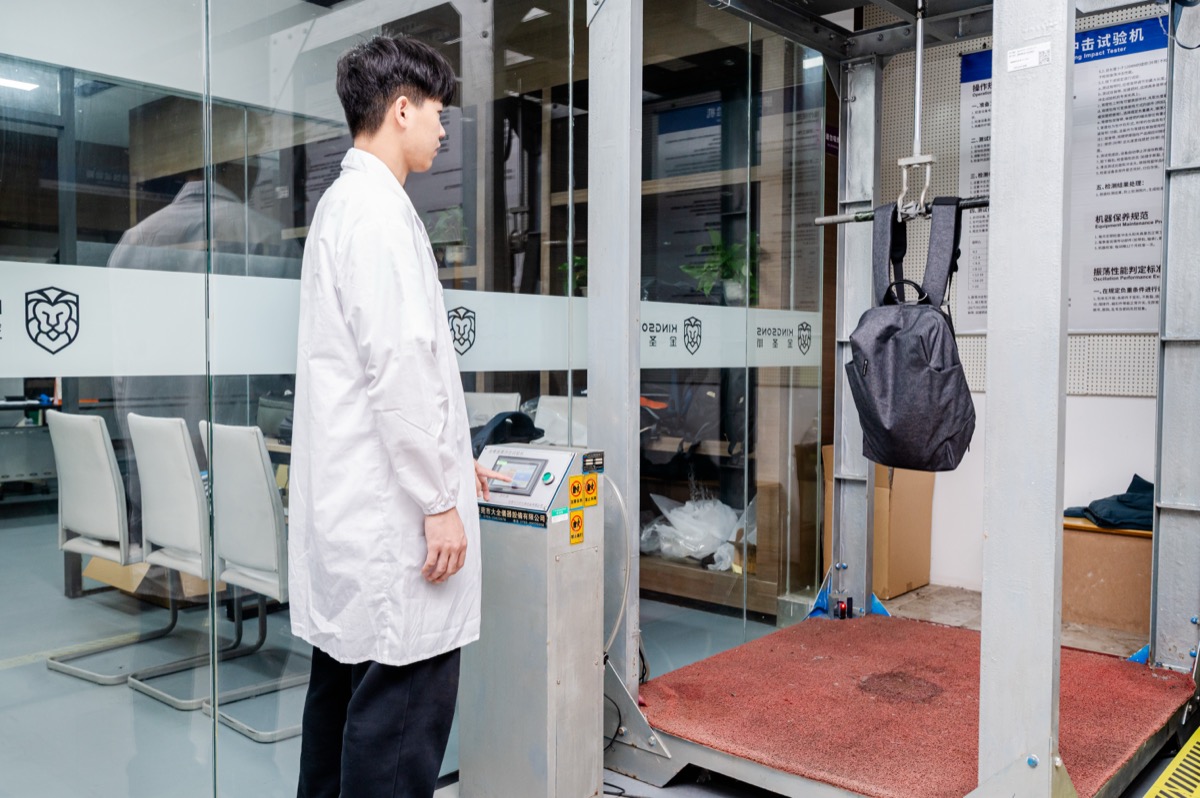
A factory that takes quality seriously maintains its own testing lab. The essential equipment list for a laptop backpack factory includes: a universal tensile testing machine (for seam and strap strength), a waterproofness tester (hydrostatic pressure), a zipper reciprocating tester, a Martindale abrasion tester, and dimensional measurement instruments.
En Kingson, the in-house testing lab runs tests at three frequencies: every incoming material batch (IQC), weekly random production pulls (IPQC), and every finished lot before FRI. This means a single order may be tested 10–15 times across the production cycle.
If your supplier sends every test out to a third-party lab like SGS or Intertek, their in-process QC is weak by definition — they only catch problems after production, not during it. Third-party testing has its place (certification audits, buyer-commissioned inspections), but it should supplement an in-house program, not replace it.
| Capability | In-House Lab | Third-Party Lab Only |
|---|---|---|
| Testing frequency | Every batch + weekly + per lot | Per lot (at buyer’s cost) |
| Defect detection timing | During production (IPQC catches drift) | After production (too late for cheap fixes) |
| Cost per test | Near zero (equipment already owned) | $200–$800 per test session |
| Speed | Results within hours | Results in 3–7 business days |
| Credibility for buyers | Good for routine QC | Higher for certification and disputes |
How Defects Are Classified in Laptop Backpack QC
Not all defects are equal. A slightly misaligned stitching line is annoying but does not affect function. A seam that fails at 400N will destroy a laptop. B2B buyers should understand how manufacturers classify defects, because the classification determines whether a production lot passes or fails the final inspection.
Critical Defects (AQL 0)
Any defect that creates a safety hazard. Broken needle fragments left inside the product, sharp metal burrs on buckles, chemical odor exceeding safe thresholds, or child-small parts on products not intended for children. Zero tolerance — a single critical defect fails the entire lot.
Major Defects (AQL 2.5)
Defects that affect function or significantly reduce saleability. Seam strength below 800N, zipper failure under 12,000 ciclos, wrong color on more than 5% of the surface area, missing logo or branding element, incorrect dimensions beyond tolerance (±5mm on critical measurements). These are the defects that generate customer returns and negative reviews.
Minor Defects (AQL 4.0)
Defects that affect appearance but not function. Slight color variation within acceptable range, loose thread ends (under 5mm), minor packaging misalignment, small adhesive residue. These do not generate returns but may reduce perceived quality. A buyer who consistently receives minor defects should address the issue with the factory before it escalates.
Need a laptop backpack manufacturer with documented QC standards and in-house testing? Kingsons runs a three-stage QC system (IQC/IPQC/FRI) across 20 production lines, with ISO 9001, BSCI, and GRS certifications.
500+ Patentes | 80 ingenieros | 12-Month Warranty
How Buyers Should Write QC Specifications Into Their Orders
The most common source of quality disputes in laptop backpack manufacturing is not that the factory cut corners — it is that the buyer never specified what “quality” means in measurable terms. A purchase order that says “high quality” or “strict QC” gives the factory no standard to meet and no consequence for missing one.
The Specification Sheet Every Buyer Should Attach
Before placing any order, attach a QC specification sheet that names exact thresholds for every test. Here is the minimum framework:
- Seam strength: Minimum 800N on all load-bearing seams. Specify which seams are “load-bearing” (shoulder strap attachment, top handle, bottom panel, laptop compartment border).
- Zipper brand and model: Name the exact zipper (p.ej., YKK #8 coil, SBS #5 reverse coil). Include a penalty clause for unauthorized substitution.
- Zipper durability: 12,000 cycles minimum on reciprocating tester. Specify which zippers are tested (compartimento principal, laptop pocket, front organizer).
- Water resistance: State the water column requirement (1,000milímetros / 3,000milímetros) and the test duration (24 horas).
- Foam density: Minimum 25 kg/m³ for laptop compartment padding. Specify EPE or EVA foam type.
- Tela: Name the exact material, denier, and source (p.ej., 600D polyester from Corcovado, or RPET nylon from a named supplier).
- Hardware: Specify SFS or ITW buckles, with UV resistance rating (500+ horas).
- Stitch density: 8–10 stitches per inch on all load-bearing seams.
- AQL levels: Major defects at 2.5, minor defects at 4.0, critical at 0.
This specification sheet becomes part of the purchase contract. When both parties agree on measurable standards before production begins, disputes after production become rare.
Inspección previa al envío: What Buyers Should Commission
For first orders or new factory relationships, commission an independent pre-shipment inspection through a service like SGS, Oficina Veritas, or Intertek. The inspector follows the ANSI/ASQ Z1.4 sampling plan, pulls random units from your production lot, and runs the tests specified in your QC sheet. The cost is typically $200–$350 per man-day — a fraction of the cost of receiving a container of defective goods.
For repeat orders with an established factory, you can rely on the factory’s own FRI reports — provided they include photographic evidence, test machine readouts, and batch traceability. A factory that provides transparent FRI reports without being asked is a factory that has nothing to hide.
Warranty and After-Sales: What a Quality Factory Offers
Quality control reduces defects, but it does not eliminate them entirely. A confident manufacturer backs its production with a written warranty. En Kingson, the standard warranty covers manufacturing defects for 12 months from the date of shipment. If a defect is confirmed as a manufacturing issue (not misuse), the factory covers replacement or repair costs.
The after-sales team responds within 24 hours of a complaint and resolves confirmed issues within 7 dias laborables. This response time matters because a defective batch discovered during a retail season needs immediate action — every day of delay means more end-customers receiving bad products and writing negative reviews.
When evaluating a laptop backpack manufacturer, ask about their warranty terms and after-sales response time. A factory that offers no warranty or takes weeks to respond is a factory that has not thought carefully about what happens after the goods leave its dock.
Conclusion
Quality control in laptop backpack manufacturing is a system, not a slogan. It requires three inspection stages (IQC, IPQC, FRI), five critical tests with measurable thresholds, in-house testing equipment, a defect classification framework, and a specification sheet that both buyer and factory sign before production begins.
QC Checklist for B2B Buyers
- Confirm your factory runs all three QC stages — not just a final inspection.
- Require exact test thresholds (800N seam, 12,000-cycle zipper, 1,000mm water column) in writing before placing an order.
- Verify the factory owns its own testing lab — outsourcing everything to third parties signals weak in-process control.
- Name exact component brands (YKK zippers, SFS/ITW hardware) in your purchase specification, with penalties for unauthorized substitution.
- Commission an independent pre-shipment inspection for first orders; rely on transparent FRI reports for repeat orders.
- Confirm warranty terms (minimum 12 meses) and after-sales response time (dentro 24 horas) before committing.
If you are looking for a laptop backpack manufacturer with a documented three-stage QC system, in-house testing lab, and ISO 9001 / BSCI / GRS certifications, the next step is a direct conversation about your specifications and quality requirements.
Preguntas frecuentes
What is the minimum seam strength for a laptop backpack?
All load-bearing seams must hold a minimum of 800 newtons (norte) pull force on a universal tensile testing machine. Below 600N, the seam will likely split under normal laptop weight within months of daily use. The 800N threshold provides a safety margin above the expected load cycle.
How is zipper durability tested on laptop backpacks?
The zipper is mounted on a reciprocating tester that opens and closes it at a consistent speed. The pass threshold is 12,000 cycles without tooth separation or slider derailment — simulating approximately two years of daily use at 15 cycles per day. Branded zippers (YKK, SBS) consistently exceed this threshold.
What is the difference between IQC, IPQC, and FRI?
IQC (Incoming Quality Control) tests raw materials before production. IPQC (In-Process Quality Control) monitors production in real time, catching defects as they occur. FRI (Final Random Inspection) tests finished goods before packaging using statistical sampling. All three stages are needed — skipping any one leaves a gap where defects can escape.
Should my backpack manufacturer have its own testing lab?
Sí. A factory that outsources all testing to third-party labs only catches problems after production, when correction costs are highest. An in-house lab enables testing at every stage — incoming materials, weekly production pulls, and every finished lot — at near-zero marginal cost.
What AQL levels should I specify for laptop backpack orders?
For laptop backpacks, set the Acceptance Quality Limit at 2.5 for major defects (functional issues like seam failure, zipper breakage, wrong dimensions) y 4.0 for minor defects (cosmetic issues like loose threads, slight color variation). Critical defects (safety hazards) should be set at 0 — zero tolerance.