
bag tech pack is the first checkpoint buyers should lock before they approve a supplier, 예산, 또는 생산 슬롯. Factories report that over 60% of initial sample errors trace back to a single source: an incomplete document. A buyer gets a perfect pre-production sample, approves it, then receives a $50,000 container where the 900D polyester was swapped for a cheaper 600D. This happens because the verbal agreement wasn’t locked into a binding bag tech pack, the one document that translates design intent into manufacturing reality.
Sending a factory a sketch with some color notes isn’t a plan. It’s an invitation for them to fill in the blanks, and they will almost always do so based on their own cost and convenience. A real tech pack is a non-negotiable blueprint. It dictates everything from the stitch count on the straps to the specific YKK zipper model and the acceptable quality tolerance for fabric dye lots. It’s the difference between getting what you designed and getting what the factory decided to make.
Why a Sketch Isn’t Enough: The Role of a Tech Pack
A sketch shows appearance.
Day 1 the order is placed. Day 14 the sample arrives and looks perfect. Day 45 the container lands at the destination port. Day 46 the warehouse calls — the foam density in the laptop compartment feels thinner, the zipper tracks are a different grade, and the shoulder strap stitching is already separating from the load-bearing panel. On a $50K order, that is not a quality dispute. That is a documentation failure.
What a Sketch Cannot Communicate
A sketch tells a factory what a bag looks like. A bag tech pack tells the production line how to build it — the exact YKK zipper model number, the stitch-per-inch on every seam type, the foam density grade inside the air-cushion laptop sleeve. Factories report over 60% of first-sample errors trace directly to incomplete spec sheets, with missing material codes and absent SPI requirements as the two top causes. Adding 3D CAD drawings to the package can eliminate an average of two physical sample rounds, shaving 4-6 weeks off the development cycle.
Three Questions to Ask Your Supplier Before Production
- BOM specificity: Can you confirm every component maps to a specific material code, not a generic description like ‘nylon’ or ‘foam’?
- Stitch specification: Will you provide a stitch-per-inch breakdown for every seam type before any fabric is cut?
- Golden sample clause: Do you agree to a clause that legally binds final production quality to the physically approved sample I sign off on?
Essential Components of a Manufacturer-Ready Tech Pack
A tech pack isn’t a suggestion; it’s the manufacturing contract that prevents costly errors and protects your investment.
Think of a tech pack as the legal blueprint for your product. It removes all ambiguity, which is the single biggest cause of production disputes and defects. Internal factory data shows that over 60% of initial sample errors trace back to incomplete tech packs. A detailed document is your primary tool for holding a manufacturer accountable for the final quality.
Bill of Materials (BOM): Specifying Fabrics, 하드웨어, and Zippers
This is the ingredient list. Ambiguity here is a direct path to failure. “Durable fabric” means nothing. You must specify the exact material, weight, and supplier. This is non-negotiable for accurate FOB pricing and consistent production.
- 구조: Specify exact type, weight, and any coatings. Example: ‘900D RPET Polyester with PU backing, GRS certified,’ not just ‘recycled fabric’.
- 지퍼: Name the brand and model. Example: ‘YKK RC (Racquet Coil) Zipper, Size #8 for main compartment.’ Reputable factories will have relationships with suppliers like YKK, SBS, 그리고 SAB.
- 하드웨어: List every buckle, slider, and D-ring by material and supplier. Example: ‘ITW Nexus acetal plastic side-release buckles,’ not ‘black clips’.
- Stitches Per Inch (SPI): Mandate the SPI for different areas. For example, 7-8 SPI on main body seams, but a higher 10-12 SPI for load-bearing points like shoulder strap connections.
- Reinforcement: Call out exactly where to put bar-tacks (dense reinforcement stitching). This should be on every handle base, strap attachment point, and MOLLE loop.
- Color Codes: Use the Pantone Matching System (PMS) for all fabrics, webbing, thread, and logos. Do not rely on screen colors.
- Artwork Specs: Provide vector artwork files (.ai, .eps) and specify the exact placement (예를 들어, ‘centered, 30mm down from top seam’), 크기, and application method (자수, 스크린 인쇄, debossed leather patch).
- Critical Measurements: Call out the finished height, width, and depth, plus dimensions for key features like laptop sleeves, pockets, and strap lengths.
- Acceptable Tolerance: Define the variance you will accept. A common standard is +/- 3-5mm on major dimensions. Without this, a 10mm deviation is a matter of opinion, not a breach of contract.
Construction Details: Stitching, Seams, and Reinforcements
How the bag is assembled determines its lifespan. These details are often overlooked by new brands, resulting in strap failures and split seams. You must dictate the construction methods.
Colorways and Artwork Placement (CADs)
Visual instructions prevent costly mistakes in color and branding. A picture with a Pantone code is worth a thousand words. Providing clean CADs is a standard part of how to create a bag tech pack that gets results.
Labeled Measurements and Tolerances
Every critical dimension needs a number. More importantly, you must define the acceptable margin of error, or quality tolerance. This gives you a contractual basis to reject a production run that doesn’t match the approved sample.
Bill of Materials (BOM): Specifying Fabrics, 하드웨어, and Zippers
Your Bill of Materials is not a wish list; it’s the manufacturing contract for every single component in your bag.
The most expensive phrase in manufacturing is ‘or equivalent.’ A factory’s sourcing manager sees that as an open invitation to substitute a lower-cost material that meets the bare-minimum spec. Your approved sample might have used premium fabric, but the production run uses a cheaper alternative that pills after three months. The BOM is where you prevent this from ever happening.
From Vague Descriptions to Verifiable Specs
Ambiguity is your enemy. It creates variance, and variance kills product quality and your profit margin. A professional BOM leaves no room for interpretation. It locks down the exact supplier and part number for every critical component.
- Zipper Specification: Weak: ‘Nylon Zipper.’ Strong: ‘YKK #5 RC (Racquet Coil) Zipper, black tape, black slider.’ This locks in a trusted supplier like YKK or SBS, preventing swaps with unbranded alternatives that may fail cycle-testing.
- Fabric Specification: Weak: ‘600D Polyester.’ Strong: ‘600D Polyester with PU coating, 210 g/m², from supplier Teijin, Color Pantone 19-4008 TCX.’ This defines the weight, 코팅, and source, eliminating variance in durability and color.
- Hardware Specification: Weak: ‘Plastic Buckle.’ Strong: ‘ITW Nexus Side Release Buckle, 25mm, Acetal, Part #SR25.’ This specifies the exact brand, 재료 (Acetal is stronger than nylon), and part number, which is critical for load-bearing straps.
Specifying down to the part number makes quoting more accurate and gives you a clear, contractual basis for rejecting a production batch if a component is substituted without your written approval. This is how you define and enforce your quality tolerance before a single unit is produced.
| Component | Category | Specification Examples | Key Supplier Brands |
|---|---|---|---|
| Main Fabrics | Performance & Synthetic | 나일론, 폴리에스테르 (방수복, Wear-Resistant), PU, PVC | Covestro, Teijin, Arkema, Anli |
| Natural & Traditional | Genuine Leather (Cowhide, Sheepskin), Canvas | Sourced from premium tanneries | |
| Sustainable & Eco-Friendly | GRS (글로벌 재활용 표준) certified materials, Recycled PET | GRS-certified supply chain | |
| Zipper Systems | Global Tier 1 | 기준, 방수복, 도난 방지, Lockable Sliders | YKK, SBS, SAB |
| 하드웨어 & Trims | 버클, Sliders, Rings | High-durability plastic and metal components | SFS, ITW |
| Auxiliary Components | Reinforcements & Foams | High-tensile webbing, shock-absorbing foams, adhesives | 3M, DuPont |
Construction Details: Stitching, Seams, and Reinforcements
The most expensive fabric means nothing if the shoulder strap rips off at the airport.
This section of the bag tech pack is where design stops and engineering begins. Vague instructions like ‘add reinforcement’ are the primary reason for sample failures. Production lines don’t interpret; they execute. If a specification isn’t on the page, it won’t be on the product. It’s that simple.
The Non-Negotiable Construction Callouts
Your supplier’s quote is directly tied to these details. Leaving them out doesn’t save money; it just invites the factory to choose the cheapest method. You must be explicit.
- Stitches Per Inch (SPI): Specify the SPI for different areas. For example: 8-10 SPI for main body seams, but a tighter 11-12 SPI for top-stitching. Anything less on a main seam is a red flag.
- Reinforcement Type: Don’t just say ‘bartack’. Specify ’42-stitch bartack’ at all shoulder strap anchors, handle bases, and webbing loops. This is a clear instruction for the factory’s intelligent sewing workstations.
- Seam Allowance & Type: Define a minimum seam allowance (예를 들어, 1/2 inch or 1.27cm) and the construction (예를 들어, ‘double-needle lockstitch on all main exterior seams’). This prevents seam slippage under load.
- Thread Specification: Call out the thread by size and type. For a durable backpack, this would be a minimum of Tex 69 (T-70) bonded nylon for all structural seams. Using standard polyester thread here is asking for warranty claims.
Defining Your Quality Tolerance
Finally, your tech pack must define the testing protocol. How will you verify the construction? Specify a load test. For instance: ‘Shoulder strap attachment point must withstand a 20kg pull test for 60 seconds without material failure or seam degradation.’ A manufacturer with a proper QC lab will use a tensile testing machine for this, providing objective pass/fail data against your specified quality tolerance.
Colorways and Artwork Placement (CADs)
A 2mm logo shift or the wrong Pantone shade are the most visible—and expensive—production errors you can make.
Providing a Pantone code is amateur hour if you stop there. PMS Cool Gray 9 C on 900D nylon looks completely different than on a PU leather patch or a metal zipper pull. The color absorbs and reflects light differently based on material texture and finish. Your tech pack’s colorway page must map each Pantone code to a specific component and material. Failure to do this is the root cause of mismatched trim and main body colors.
Specify the Application, Not Just the Art
The factory’s pattern maker needs exact instructions. A callout for a logo must specify the method—is it a silk screen, high-frequency weld, 자수, or a stamped metal plate? Each has different production tolerances. Your CAD must define the artwork’s dimensions and its precise placement with measurements from at least two perpendicular edges (예를 들어, “3.5cm from top seam, 5.0cm from side seam”).
Virtual Approval Before Physical Samples
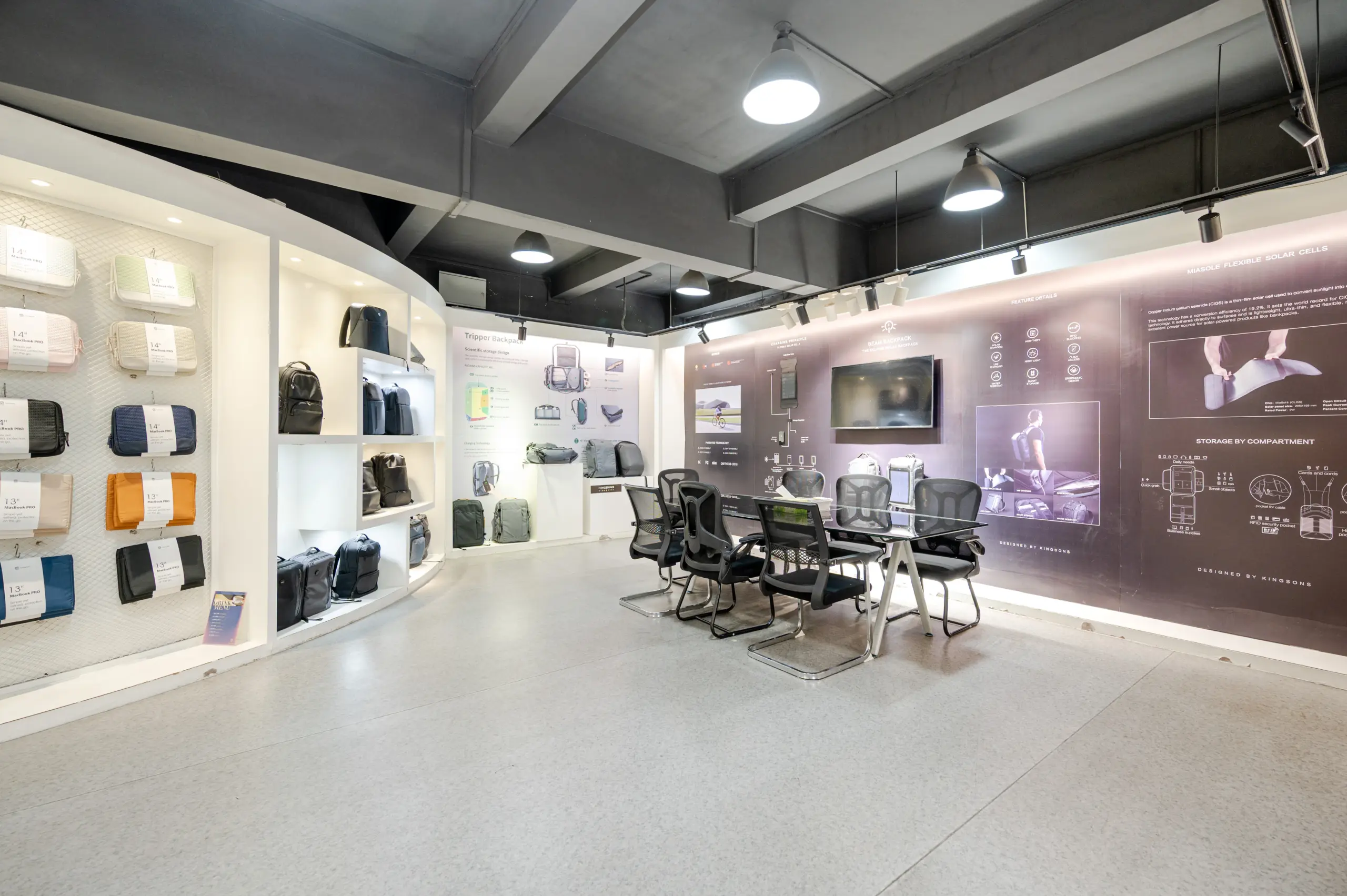
This is where you separate professional suppliers from the rest. Before committing to a physical sample, demand a digital proof laid out on the 2D pattern files or, even better, a 3D CAD render. Facilities with in-house design teams, like Kingsons’ 20-person R&D department, use 3D systems to model this. It allows you to catch placement and proportion errors digitally, which can eliminate an entire round of physical sampling and cut 4-6 weeks from your development timeline.
Labeled Measurements and Tolerances
에이 +/- 5mm tolerance drift on a 10,000-unit order means thousands of bags won’t fit the product they were designed for.
Saying ‘a 15-inch laptop pocket’ is an invitation for disaster. Does that mean the pocket is 15 inches wide, or that it fits a specific 15-inch laptop model? The difference can be a full centimeter. Without precise, labeled measurements for every component on your technical drawing, you are leaving the interpretation to the pattern maker. That’s a gamble you can’t afford on a large production run.
Beyond Dimensions: Defining the Margin of Error
No two handmade items are identical. Fabric stretches and sewing has allowances. The quality tolerance defines the acceptable deviation from your spec. A tight tolerance (예를 들어, +/- 2mm) signals a high-end product and requires superior process control. A loose tolerance (+/- 5mm or more) is cheaper to produce but results in visible inconsistencies across a batch.
- Critical Dimensions: Specify final HxWxD, but also internal pocket dimensions and strap lengths. Use millimeters. Example: Laptop Compartment Inner Width: 360mm (+/- 2mm).
- Placement Points: Define the exact position of logos, labels, and hardware from the nearest seam. Example: ‘Woven label 20mm from left seam and 15mm from bottom seam (+/- 1.5mm).’.
- Functional Fit: Don’t just spec the pocket; spec the object it must hold. This is a key check during the sample approval stage, ensuring real-world function before mass production.
Achieving this consistency isn’t accidental. It’s the result of disciplined process control, often validated by an ISO 9001 인증. Leading manufacturers use 3D patterning systems and dedicated dimension measurement instruments to ensure the CAD file translates into a physical product with minimal deviation. A factory’s ability to replicate the approved sample 300,000 times a month depends on this technology, not just skilled hands.
Common Tech Pack Mistakes and How to Avoid Them
A vague tech pack is an invitation for your supplier to guess.
Brands have lost $50K orders because the mass-produced bag didn’t match the approved sample
The Most Expensive Assumptions to Avoid
- Vague Materials: Don’t write ‘black polyester.’ A professional bag tech pack specifies: ‘600D Polyester with PU backing, Pantone 19-4004 TCX.’ List the exact zipper model, like a YKK #5 coil, not just ‘zipper’.
- Missing Construction Details: Forgetting to specify 8-10 stitches-per-inch (SPI) on a load-bearing strap is why handles rip off. You must define this quality tolerance, otherwise you have no grounds to reject a poorly made batch.
- Imprecise Artwork Placement: A sketch showing a logo ‘on the front pocket’ is a recipe for disaster. A manufacturer-ready pack includes CAD files with X/Y coordinates. This single step can cut down sample iterations by half, saving weeks of time.
Ultimately, your tech pack should reference a physically approved ‘golden sample.’ This legally ties the entire production run to a tangible standard you’ve held in your hands. If a detail isn’t in the pack or on that sample, it doesn’t exist.
Downloadable Basic Bag Tech Pack Template
Forget sending a sketch and hoping for the best. A professional bag tech pack isn’t a “nice to have”; it’s the blueprint that separates a smooth production run from a costly disaster. An incomplete pack is a direct invitation for the factory to make assumptions, and those assumptions will always be in favor of their margin, not your quality.
Anatomy of a Professional Tech Pack
A document that prevents errors must be ruthlessly specific. Your template should have, at minimum, these non-negotiable sections. This is precisely the level of detail our 20-person R&D team uses to translate a concept into our 3D CAD system for prototyping, often cutting down the need for multiple physical samples.
- Bill of Materials (BOM): Don’t just write “black fabric.” Write “Main Body: 900D Recycled Polyester, 검은색, PU Coated. Lining: 210D 폴리에스테르, Grey.” Specify the zipper supplier (예를 들어, YKK, SBS) and model number. Every single component needs a line item.
- Construction & Stitching: Call out stitches-per-inch (SPI) for key seams—8 SPI is standard, but load-bearing straps may need 10-12. Specify bartacks at all stress points like shoulder strap attachments and handle bases.
- Measurements & Quality Tolerance: Every dimension must be listed with an acceptable variance. A professional standard is +/- 3mm. Anything outside that range is grounds for rejection during QC. This single detail protects your entire order.
- Artwork & Colorways: Provide Pantone (PMS) codes for all colors. Show exact placement and dimensions for logos, 자수, or prints. Specify the application method: 스크린 인쇄, 열전달, or embossed metal plate.
- Packing & Labeling: Define how each bag is folded, whether it goes in a polybag with a suffocation warning, how many units go into a master carton, and the exact text and layout for shipping marks. Don’t let this be an afterthought.
Here is your benchmark for the next supplier call. Internal audits and factory floor data show that over 60% of initial sample errors are due to incomplete tech packs, usually missing material codes or SPI requirements. A complete document isn’t about being difficult; it’s about eliminating the ambiguity that costs you time and money. Use a thorough template and you immediately put yourself in the top 40% of buyers who get it right the first time.
결론
A bag tech pack is not administrative paperwork; it is the single most critical document that protects your investment. Ambiguity in your specifications leads directly to inaccurate FOB pricing, production mistakes, and quality disputes that surface long after your goods have shipped. A precise, detailed tech pack is your primary defense against costly misunderstandings and ensures the final product matches the one you approved during the sample approval stage.
- Specify every component in the Bill of Materials, down to the exact supplier code for zippers and fabric.
- Define all construction details, including stitches-per-inch (SPI) and reinforcement methods at stress points.
- Establish a clear dimensional quality tolerance, such as ±3-5mm, to create an objective standard for inspection.
- Reference the approved ‘golden sample’ within the tech pack to legally connect it to your production agreement.
Here is the industry benchmark to measure your process against: a professional-grade tech pack should get you to a final, approved sample in two rounds or less. If your team is consistently going through three, four, or more iterations, the problem isn’t the factory—it’s your specification document. Use this two-round standard to audit your current process and identify gaps. For clear examples of bags built on precise manufacturing specifications, reviewing the construction of established product lines can provide a tangible reference for your own designs.
자주 묻는 질문
What is the custom bag MOQ with a tech pack?
The standard minimum order quantity for custom OEM or ODM bags is 500 pieces. This threshold applies once your tech pack and customization details are fully finalized. Expect lower MOQs only if you pivot to existing stock designs.
Should I specify zipper brands in my tech pack?
예, you must specify exact brands or tier levels in your Bill of Materials. Factories typically source from partners like YKK, SBS, or SAB, which directly impacts your unit cost and lead. Always list an acceptable alternative brand to prevent production delays.
Can I include smart features in the tech pack?
You can include smart features like RFID blocking or USB ports in your tech pack specs. These additions require specialized engineering to pass safety certifications like CE or FCC. Request a technical feasibility review before finalizing electronic specs.
How long does sampling take after submitting a tech pack?
Producing a pre-production sample typically takes 7 에게 10 days once the factory receives your complete tech pack. This timeline assumes all specified materials are readily available. Budget extra time if your tech pack requires custom hardware molds.