Behind every custom tote there is a manufacturing sequence most buyers never see: fabric chosen by weight, panels cut in layers, handles bar-tacked, decoration applied on the right line at the right moment, and finished bags inspected against a standard. Knowing that sequence is what separates a buyer who can specify a tote from one who can only pick from a catalogue. This walkthrough follows a tote from roll of fabric to shipped carton, and shows where the cost, quality and lead-time decisions actually get made.
주요 시사점
- A tote is built in six stages — material selection, 절단, decoration, sewing/assembly, QC and packing — and the point at which decoration happens (before or after sewing) shapes the whole line plan.
- Fabric choice by GSM and fibre is the dominant cost driver; a 70 GSM non-woven bag and a 320 GSM cotton canvas tote share almost nothing in their bill of materials.
- Decoration method (스크린 인쇄, 열전달, 자수, labels) is chosen against fabric weight and logo complexity, not personal preference.
- Practical MOQ: logo-on-stock from 200 조각들, custom colour from 500 per style/colour, bespoke construction from 1,000; mass production runs 30–45 working days.
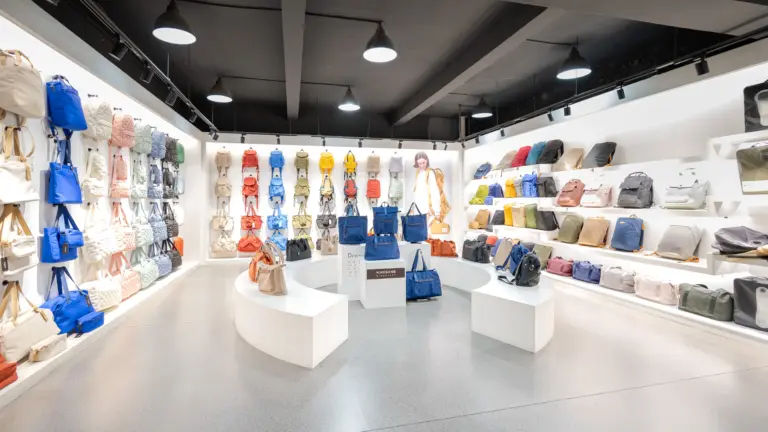
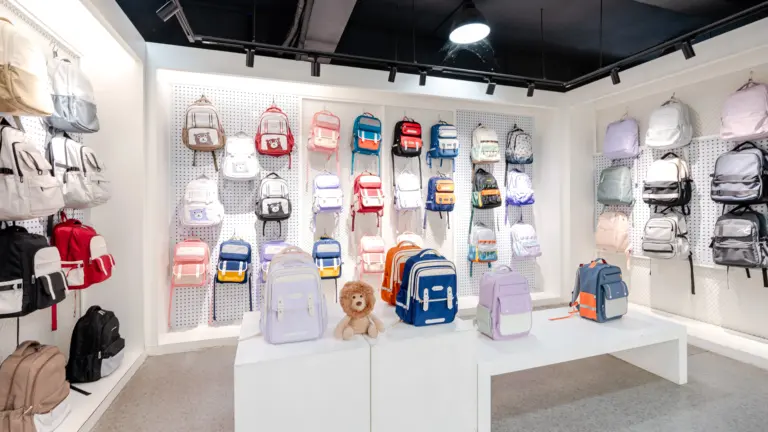
- Kingsons manufactures fashion and promotional bags across 20 lines in a 50,000㎡ Guangzhou campus at 300,000 units/month, with GRS, BSCI, SEDEX and ISO certification and in-house decoration.
The Six-Stage Manufacturing Sequence
Whatever the fabric or the branding, a soft bag moves through the same basic path. Understanding it lets a buyer place their own decisions in the right slot:
| Stage | What Happens | Buyer Decision Made Here |
|---|---|---|
| 1. Material selection | 구조, lining, webbing, thread, hardware specified and sourced | Fibre, GSM, 색상, 인증 |
| 2. 절단 | Patterns laid and cut in plies on automated cutters | Dimensions, gusset, panel layout |
| 3. Decoration | Print/embroidery/label applied, often before assembly | Method, 놓기, colour count |
| 4. Sewing / assembly | Panels joined, handles and gussets attached, turned | Handle type, reinforcement, closure |
| 5. Quality control | Inline and final AQL inspection, measurements, function checks | AQL level, tolerance, tests |
| 6. Packing | Fold, polybag, insert, carton, label | Presentation, per-carton quantity |
The rest of this guide takes each stage in turn, because each is where a specific cost or quality outcome is decided.
Stage 1 — Material Selection: The Real Cost Lever
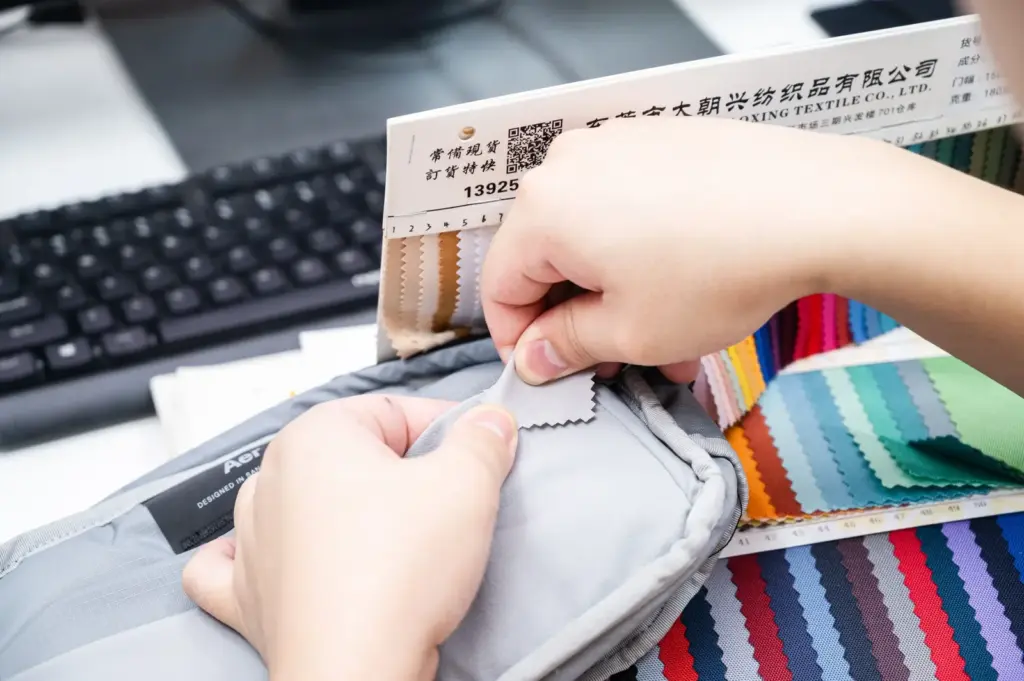
For a tote, the fabric is most of the product. Material selection decides hand-feel, 내구성, print behaviour, 무게 (and therefore freight) and price:
- Non-woven polypropylene (NWPP) — the promotional workhorse; spun-bond, cheap, screen-prints well, short service life.
- Cotton canvas / 오리 — woven, structured, comfortable hand; heavier, prints and embroiders well; the reusable-retail standard.
- 폴리에스테르 / 600D Oxford — strong, colour-fast, water-resistant; for higher-wear totes and shoulder-carry styles.
- Recycled cotton, rPET, organic cotton — sustainability-led programs; certified fibre with GRS or organic documentation.
The variable buyers should specify is GSM (grams per square metre) 그리고, for wovens, the weave count. 에이 70 GSM non-woven is a giveaway; a 320 GSM cotton is a product. Fabric is sourced through a controlled supply chain — Kingsons works named material suppliers for fabric, webbing and hardware (YKK를 비롯한, SBS and SAB zipper systems), and every incoming material is REACH and California 65 compliant. 그만큼 custom bag materials guide covers fibre behaviour in more depth.

Stage 2 — Cutting: Precision and Ply Height
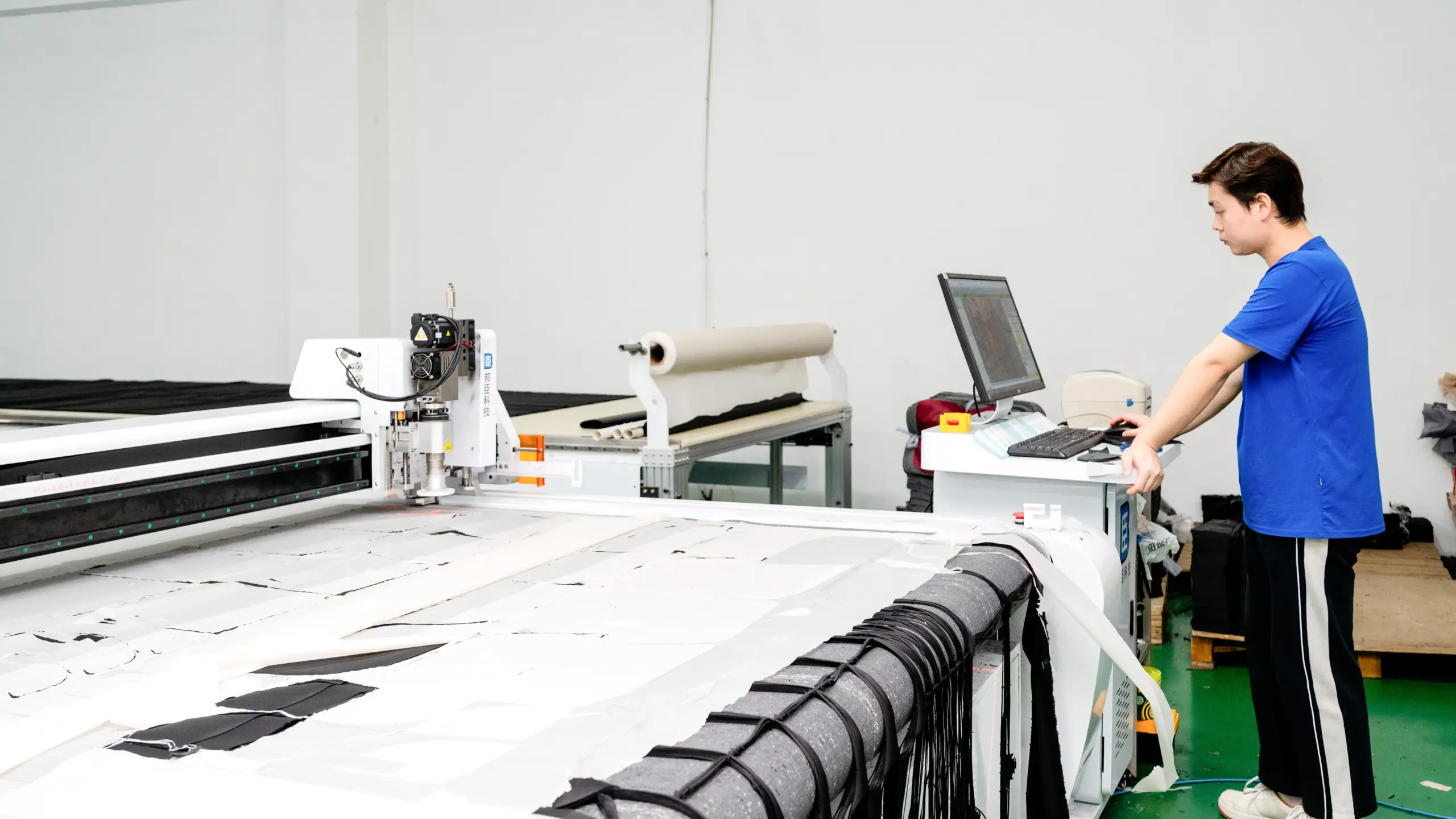
Cutting turns fabric rolls into panels. On volume tote production this is layered — many plies cut at once with an automated cutter — which is what makes thousands of identical panels economical.
- Ply height — how many layers cut per pass; higher plies mean better economics but tighter control of fabric shift.
- Pattern nesting — how panels are laid to minimise fabric waste; a material cost the buyer rarely sees but always pays for.
- Marking and bundling — cut pieces are bundled and matched so sewing receives colour- and lot-consistent sets.
Cutting accuracy shows up downstream as aligned seams, square logos and matching panel colour between the front and back of a bag. Kingsons’ cutting workshop runs automated cutting and laser equipment with fabric pre-shrinking, which matters for cotton canvas that would otherwise move after sewing.
Stage 3 — Decoration: Where and How Branding Goes On
Decoration can be applied before assembly (on flat panels) or after (on finished bags). Flat-panel decoration is faster and cheaper for print; finished-bag decoration suits small embroidery and labels. The method itself is chosen against the fabric and the artwork:
- 스크린 인쇄 — flat, bold, economical at volume; one screen per colour; best on smooth light fabrics.
- Heat transfer — photographic detail and gradients; a film pressed on; good for smaller runs.
- Embroidery — stitched thread, raised and durable; needs a stabilised, heavier fabric to carry the stitch count.
- Woven / rubber labels and metal badges — applied brand marks that outlast surface printing.
At Kingsons the decoration line runs embroidery, screen-print, heat-transfer and debossing stations in-house, so the artwork dictates the process rather than the factory’s limitations dictating the artwork. That is also why a physical strike-off on the actual fabric is the correct approval step — thread and ink shift colour between a screen and cotton.


Stage 4 — Sewing and Assembly
This is where a tote becomes a three-dimensional object and where durability is won or lost. The construction points that matter to a buyer:
- Seam type and stitching — a straight stitch on a thin tote fails sooner than a French or bound seam; stitch density (SPI) affects strength.
- Handle attachment — the single biggest load-bearing decision; handles bar-tacked into the seam and reinforced carry far more weight than a stitched-on strip.
- Gusset and base — a gusseted base lets the bag stand; a flat panel ships flatter and cheaper.
- Turnings and finishing — how edges are finished affects both appearance and fraying over the product life.
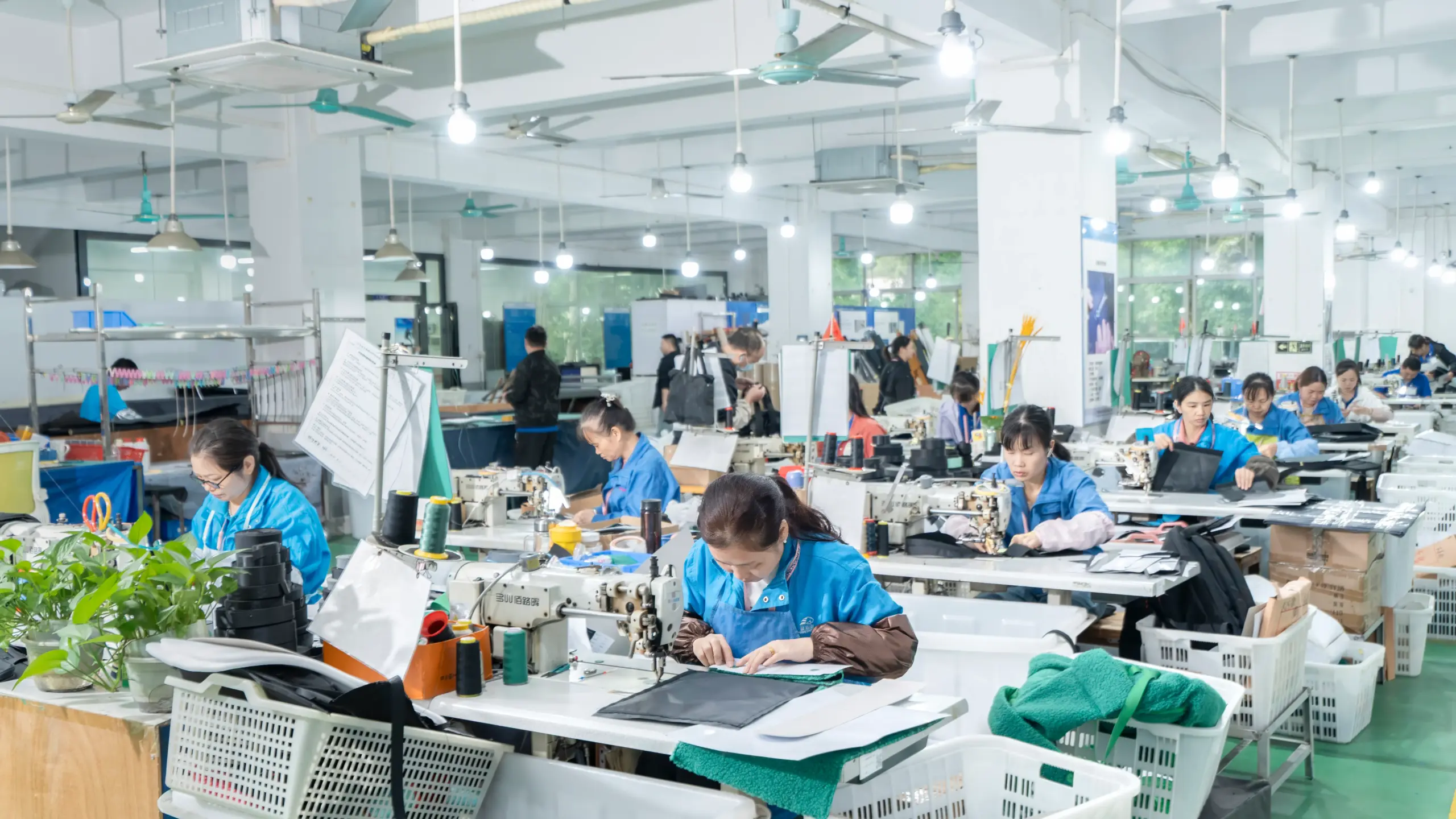
Sewing is the most labour-intensive stage; on the Kingsons floor, high-speed lockstitch and multi-needle machines assemble panels into finished bags, with time on the line scaling from a few minutes for a simple tote to longer for padded or multi-compartment styles.
Stage 5 — Quality Control
Quality on a tote is mostly about decoration and construction rather than the fabric itself. The tests a serious buyer writes into the order:
- Colourfastness and rub testing — confirms print and dyed fabric will not transfer or fade.
- Handle pull / tensile testing — load-bearing verification on the seam that fails most in the field.
- Print adhesion — a wash and flex test so screen print does not crack or lift.
- Dimensional and stitching checks — panel size, seam allowance, logo placement tolerance.
- Final AQL inspection — a sampling plan (Acceptable Quality Level) agreed before shipment releases the batch.
Kingsons runs a dedicated inspection floor with tensile, colourfastness and hardware test equipment, applying the same gates to a $1 promotional tote as to a premium retail product. The defect-prevention side is covered in the manufacturing defects prevention checklist.
Stage 6 — Packing and Freight Reality
Packing looks simple but carries two cost consequences for a bulky, light product like a tote:
- Presentation — folding method, polybag, hangtag, tissue or gift box; each adds per-unit cost and packing time.
- Volumetric weight — totes are light but take space; carton dimensions and how many pieces nest per carton drive freight cost more than the tote’s actual weight.
Agree carton quantities and labelling with the supplier before production, especially for multi-destination programs, because repacking after the fact is expensive and slow. Standard packing is a single polybag and carton; gift boxes and inserts are optional line items.
MOQ, Lead Time and the Cost of Customisation
Each stage above has a setup cost, and MOQ exists to amortise it. The practical thresholds at Kingsons:
| Customisation | MOQ | Production Lead Time |
|---|---|---|
| Logo on stock bag, stock colour | 200 pcs | 15–20 days |
| Stock shape + custom colour | 500 pcs / 색상 | 25–35 days |
| Custom size, handles, 구조 | 1,000 pcs | 35–45 days |
| Full ODM (new pattern, 압형) | 1,000–3,000 pcs | 45–65 days |
Sampling takes 7–10 working days ahead of mass production, which runs 30–45 working days for a custom order. Trial orders of 200–300 pieces can be negotiated at adjusted pricing, and small-batch flexible runs start from 50 pieces for pilots. To see how each setup stage converts into unit price, the manufacturing cost breakdown follows the same six stages.
How to Vet a Tote Manufacturer
A tote is simple enough that almost any bag workshop can claim to make one — which is exactly why capability needs verifying before a large order:
- In-house decoration — can the factory print and embroider under its own roof, or is it subcontracting and adding risk to your lead time?
- Material control — does it source named-brand fabric and hardware, and can it produce certification for the claim you need?
- QC equipment — ask what physical tests run on the floor, not just whether there is a “quality department”.
- Certification — BSCI/SEDEX for social compliance, GRS for recycled content, ISO 9001/14001/45001 for management systems.
- Sample truth — the pre-production sample is a preview of your batch; judge it against the strike-off, not a marketing photo.
Kingsons is a national high-tech enterprise with 500+ patents and 20+ international design awards, operating a 50,000㎡ campus since 1997 — the kind of manufacturing depth that shows in consistency across a large, multi-carton order. 그만큼 manufacturer-selection guide expands this into a full checklist.
자주 묻는 질문
How are tote bags manufactured?
A tote moves through six stages: material selection, 절단 (usually layered panels on an automated cutter), decoration (스크린 인쇄, transfer, embroidery or labels, applied flat or on the finished bag), sewing and handle attachment, quality inspection, and packing. The point at which decoration happens and the reinforcement of handles are the two decisions that most affect both cost and durability.
What fabric is used for tote bags?
The main options are non-woven polypropylene for cheap promotional bags, cotton canvas or duck for reusable retail and gift totes, polyester or 600D Oxford for heavier wear, and recycled cotton, rPET or organic cotton for sustainability-led programs. Fabric is specified by weight (GSM) — a 70 GSM non-woven and a 320 GSM cotton are effectively different products with different bills of material.
How long does tote bag production take?
A pre-production sample takes 7–10 working days. Mass production runs 30–45 working days for a custom tote, faster for a logo-on-stock order. A fully bespoke ODM program with new tooling and packaging runs longer, and transit time (sea or air) is added on top, so total lead time is planned backwards from your delivery date.
What is the minimum order quantity for custom totes?
킹슨스에서, a logo on a stock tote starts at 200 조각들, a custom colour at 500 색상별 스타일별 조각, and a bespoke size, handle or fabric at 1,000 조각들. Trial orders of 200–300 pieces can be negotiated, and small-batch flexible runs start from 50 조각들. Colour count, not just quantity, is what multiplies the effective MOQ because each colour is a separate run.
Which decoration method is most durable on a tote?
Embroidery and sewn or metal labels last the life of the bag, whereas screen print and heat transfer can crack or lift over washes depending on ink and adhesion. The right choice is set by fabric weight — embroidery needs a heavy, stabilised cloth to carry the stitches — and by artwork complexity, since photographic gradients need transfer, not print. Kingsons runs all four methods in-house to match process to design.
Can I produce a fully custom tote design from scratch?
예. Kingsons offers ODM development where a concept or market brief is turned into a production pattern by the in-house design team — custom dimensions, handles, 구조, lining and features. Full ODM typically starts at 1,000–3,000 pieces because the pattern, tooling and material sourcing are all new. Explore capability and start a project via the fashion bags range or the OEM/ODM team.
BUILD your tote line with a manufacturer that controls fabric, 절단, decoration and QC under one roof — from logo-on-stock to full bespoke ODM.