The USB port on a backpack is one of the most searched features in tech bags and one of the most misunderstood in sourcing. Buyers want the convenience; few know what they are actually specifying.
Here is the fact that reshapes the whole conversation: the port is not a charger. It is a connector. Everything that makes the feature work — the battery, the wiring, the placement, the safety testing — sits behind it. This guide breaks down the architecture, the specification lines that matter, and how to source the feature without ending up with a returns problem.
주요 시사점
- A USB charging backpack routes power from a rider’s own battery through built-in wiring to an external port — the port itself stores and generates nothing.
- Three integration models exist: pass-through port only, bundled power bank, and cordless-charging pocket versions; each carries different cost, freight and compliance implications.
- Specify port type (USB-A, USB-C), electrical rating, cable routing, strain relief and weather protection at the port — these are the failure points.
- Electrical features need their own QC: continuity checks, insertion-force cycling, pull tests on the cable exit and waterproof-flap function.
- Custom USB-feature backpack programs start around 500 pieces per style at an OEM factory, with 7–10 day sampling and 30–45 day production.
What a “USB Charging Backpack” Actually Is
Every consumer-facing USB backpack on the market works the same way. A short charging cable runs from an external port — usually on the side panel or top handle area — into an internal pocket that holds a power bank. The rider puts their own battery in the pocket, plugs their phone into the port on the outside, and the bag becomes a tidy cable manager rather than a power source.

Some versions ship with a bundled power bank included in the retail package; others advertise “battery not included” and let the rider supply any standard bank. A third group replaces the wired port with a wireless-charging pocket — a padded shelf against the lining where a phone charges from a bank in an adjacent pocket. Kingsons’ smart tech line spans USB-A, USB-C and Qi wireless configurations, which is exactly why the specification conversation matters: the three architectures sell at different prices and fail in different ways.
Three Integration Models Compared
| 모델 | What Ships in the Box | Unit Cost Impact | Freight & 규정 준수 | 최고의 대상 |
|---|---|---|---|---|
| Pass-through port | Port + internal cable + battery pocket only | Lowest — connector and wire | No batteries, no lithium shipping rules | Mass retail, promotional programs, first feature lines |
| Bundled power bank | Port + cable + branded bank included | Adds battery cost and retail price | Lithium shipping and UN 38.3 documentation apply | Premium DTC positioning, gift sets |
| Wireless pocket | Padded charging shelf + cable to bank | Moderate — Qi pad and routing | Bank still usually rider-supplied | Tech-forward commuter lines |
The pass-through model is the sourcing sweet spot for most brands: it carries the feature’s marketing value without the battery’s cost and logistics. The bundled model converts better where unboxing experience drives purchase decisions — but it changes your compliance file completely.
Port Types and the Electrical Specification
Ports are cheap; wrong electrical ratings are expensive. Two ports that look identical on a sample can be rated entirely differently.
- USB-A — the classic rectangular connector. Ubiquitous rider batteries output through it, but it is the older standard and limits fast-charge conversations on spec-driven retail listings.
- USB-C — reversible, the current default on phones and laptops, and the port buyers filter for. If you are launching a new program in 2026, USB-C is the specification to lead with, ideally alongside one legacy USB-A port.
- Pass-through ratings — a port is only as good as the wire behind it. Specify the conductor gauge, the rated current (commonly in the 1–2.4 A class per port for bag integrations), and whether the internal cable supports fast-charge protocols or defaults to standard 5 V output.

Put the electrical line items in your RFQ explicitly: port type per port, number of ports, rated voltage and current, conductor specification, and whether the internal lead terminates in a USB input that fits standard power banks. Suppliers quote to the paper you give them.
Placement, Routing and the Details That Fail
The failure reports in this category are almost never port failures — they are cable and installation failures. Four design decisions control the outcome:
- Port position. Side panels near the grab handle read best and keep cables short; back-panel ports tangle against the rider. Position the port on the side closest to where the battery pocket sits.
- Cable routing. The internal lead should run in a bonded channel or clip path, never loose in a compartment where scissors and charger bricks chafe it.
- Strain relief. Where the cable meets the port assembly takes every yank the bag suffers. A molded boot or grommeted exit with a service loop absorbs it; a raw pass-through grommet does not.
- Weather protection. An uncovered port is a rain inlet. Rubber flip caps or recessed port placement keep splash out — and if the product carries any water-resistance claim, the port enclosure has to hold up under the same test.
These are classic preventable defects. 우리의 bag manufacturing defect prevention checklist covers how to catch wiring and strain-relief issues at prototype stage before they tool into production.
Testing the Electrical Feature Before It Ships
Textile factories with electronics experience run a defined test set on USB models. Ask which of these are in the QC plan, in writing:
| Check | What It Catches | Typical Method |
|---|---|---|
| Continuity test | Broken conductors, cold solder joints | Every unit or AQL-sampled with a USB tester on the line |
| Insertion/extraction cycling | Loose contacts, housing cracks | Repeated connector cycles on sampled ports, functional check after |
| Cable pull test | Strain-relief failure at the port exit | Specified force applied to the lead, continuity re-checked |
| Port flap function | Weather cap detachment or poor closure | Cycle the cap, inspect hinge and seal surface |
| Loaded run check | Heat at connectors under charge current | Sampled units run at rated current, touched/inspected for heat rise |
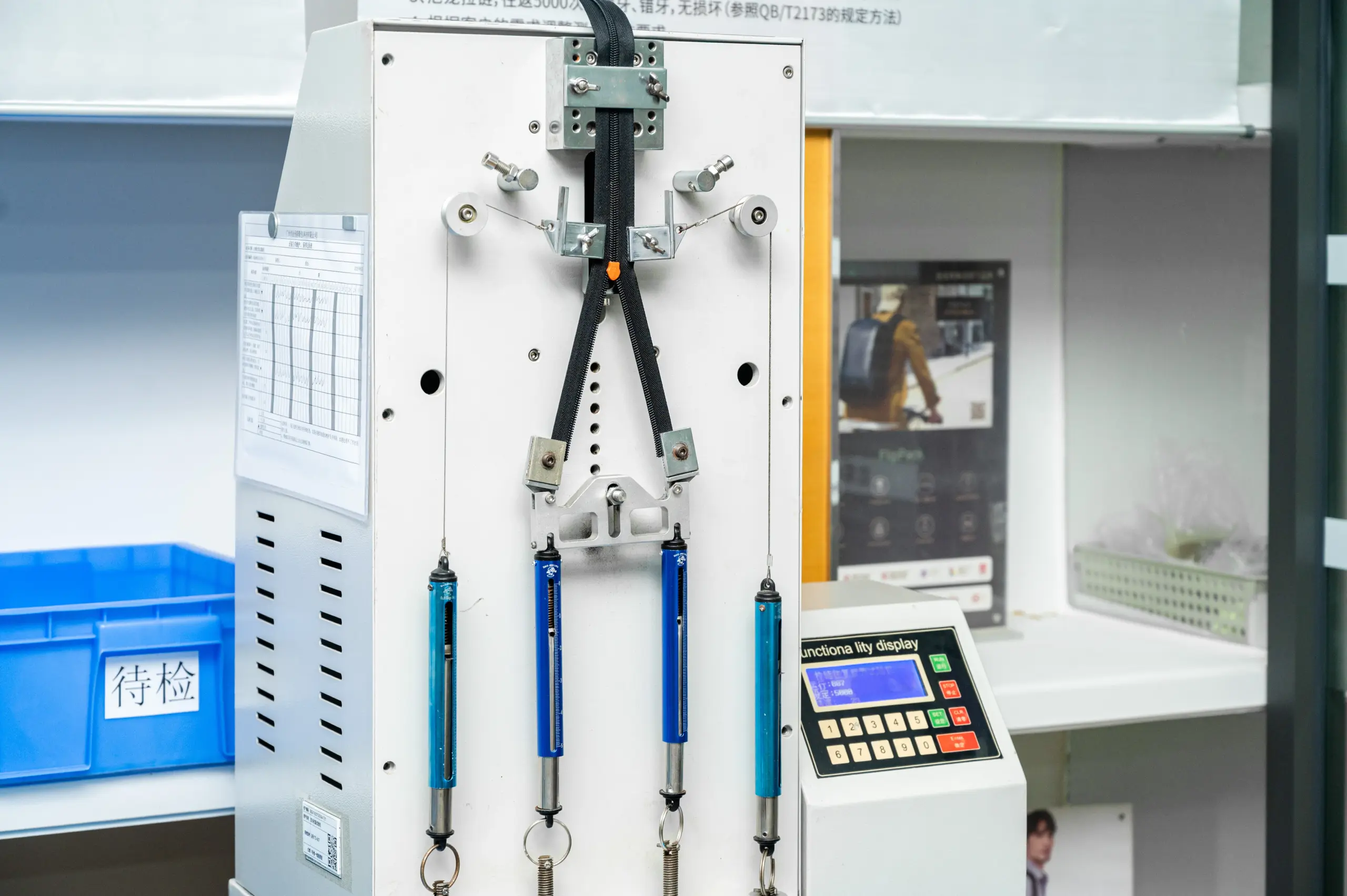
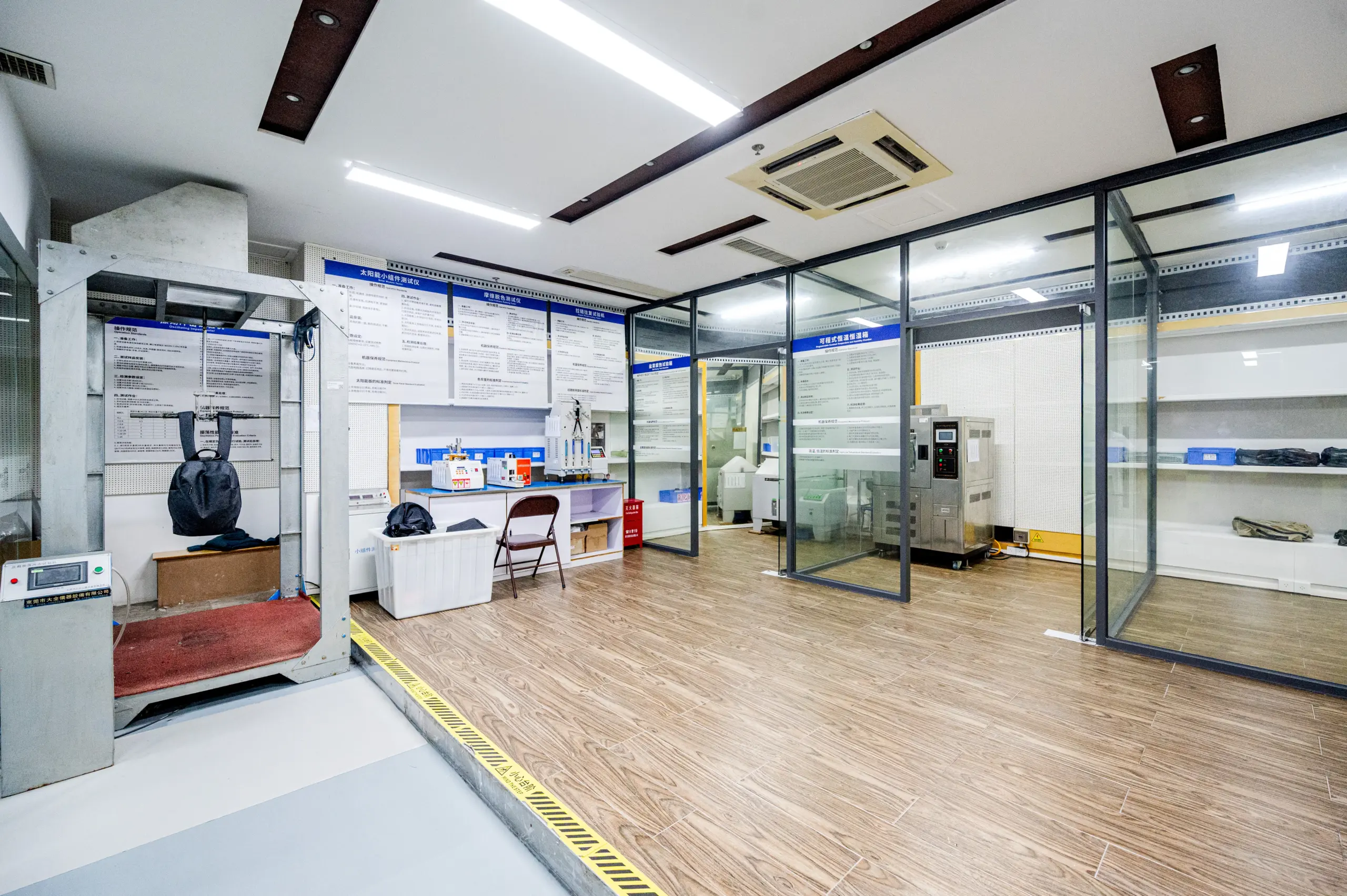
Kingsons’ quality system covers these alongside the mechanical protocol — tensile testers, zipper reciprocating machines and full IQC-to-final inspection flow under ISO 9001 — which is the practical meaning of “electrical-feature capable” in a textile factory. 그만큼 quality control testing guide details how the mechanical suite is organized.

Safety and Compliance Basics
The compliance file for a USB backpack splits by architecture:
- Pass-through models carry minimal electrical obligations — the port and wire are passive. Substance compliance (RoHS in the EU, and standard material restrictions elsewhere) still applies to connectors and cable insulation.
- Bundled-battery models turn the bag into a lithium battery shipment: UN 38.3 test summaries, packaging instructions, state-of-charge limits for air, and CE/FCC declarations for the battery electronics.
- Wireless versions add the Qi transmitter to the electronics stack with its own certification path.
Decide the architecture with your freight plan visible. A bundled model that cannot fly at peak season is a missed promotion no amount of marketing fixes.
Customization Beyond the Port
The charging feature anchors a customization program the same way any flagship function does:
- Port bezel and flap color matched to brand palettes; port count and type mix per model tier.
- Battery pocket design — elastic channels, zippered vaults or RFID-lined compartments sized to the banks your customers actually own.
- Branding — embossed logo plates, custom zipper pulls, woven labels, Pantone-matched webbing and linings.
- Structure — airbag shock-protected laptop compartments, anti-theft zippers and organizer layouts built around the charging zone.
Whether these sit on a catalog base or a bespoke shell follows the standard OEM versus ODM development paths, with the usual MOQ and tooling trade-offs attached.
MOQ, Lead Time and Where the Cost Lives
A USB feature adds a few dollars of connector, cable and labor to a bag that otherwise costs the same to cut and sew. The commercial frame at Kingsons:
- MOQ: 500 pieces per style per color for custom programs; trial orders of 200–300 negotiable with price adjustment.
- 샘플: 7–10 working days from confirmed spec — the port assembly and routing are prototyped with the shell, not after it.
- 생산: 30–45 days after approval across 20 smart production lines and a 300,000-piece monthly capacity.
- Payment: T/T 30/70, L/C at sight or Trade Assurance.
Cost pressure in this category concentrates in the port hardware grade and the QC depth behind it — the same two places where a cheap quote quietly removes what the feature depends on. 그만큼 manufacturing cost structure guide breaks down where quote differences actually come from.
Vetting a Supplier for Charging Feature Bags
Any factory can bolt a port to a panel. Before issuing the order, verify:
- Existing production evidence for wired models — port type variety, routing documentation, QC records on continuity and pull tests.
- Component sourcing: who makes the port assembly and cable, and to what rating.
- Certification stack that covers electronics: ISO 9001 process control, RoHS/CE/FCC testing capability for bundled versions, and social audit coverage (BSCI, 삼) for your retail channel.
- A development process that includes the electrical feature in the prototype review rather than treating it as an accessory.
The full vetting sequence — audits, capacity checks, documentation review — is laid out in our laptop backpack manufacturer vetting checklist.
자주 묻는 질문
Does a USB charging backpack charge itself?
No — and no model on the market does. The built-in port and cable simply extend a power bank the rider places inside the bag. Unless the product explicitly bundles a battery, the customer supplies it. Getting this point right in your listing copy prevents the single largest source of negative reviews in the category.
USB-A or USB-C port for a backpack — which should we specify?
Lead with USB-C: it is the connector on current phones and laptops, the one search demand favors, and the one that supports fast-charge positioning. A dual configuration — one USB-C plus one USB-A — covers riders with older banks and cables at trivial extra cost, and gives retail listings two spec lines to sell against.
Do the bags ship with a power bank included?
Only in bundled configurations, and many brands deliberately exclude it. Rider-supplied banks keep freight simple — no lithium battery shipping restrictions — let customers use a battery they already trust, and protect unit price. Bundling works when the unboxing moment matters enough to carry the compliance and freight cost of shipping cells.
What usually breaks on a USB backpack?
The cable, not the port. Repeated pulling at the port exit fatigues the conductor where strain relief is weak, and loose internal wiring chafes against contents until a conductor breaks. Specify bonded cable routing, a molded strain-relief boot at the port, and pull testing on the production sample, and the failure curve flattens.
Are USB backpacks safe in the rain?
5-volt USB in a damp bag is not a shock hazard — the risk is corrosion and contact failure at the port over time. Quality designs recess the port or add a rubber flip cap, and the connectors are rated for more mating cycles than a rider will use. Keep the water-resistance claim aligned with what the port enclosure actually passes in testing.
How much does adding a USB port change the bag cost?
On a pass-through model, the delta is the port assembly, internal cable, a small sewing step and added QC — a few dollars per unit at program volumes, far below the price premium the feature supports. Bundled-battery versions add the full cost of the cell and its compliance freight. MOQ and timing stay at standard factory terms: about 500 pieces per style per color, 7–10 day samples, 30–45 day production.
Build a charging-feature line on a factory that specs, tests and documents the electrical side.