A bag can pass every quality check and still get stuck at an Amazon fulfillment center. When that happens, the seller pays: unplanned prep fees, inbound defect charges that rose sharply in 2026, relabeling, or in the worst case refused inventory. None of it is about the bag itself. It is about the poly bag, the label and the carton it arrived in.
This guide covers Amazon’s FBA packaging rules for bags — bagging, suffocation warnings, FNSKU labeling, carton standards — and what to put in your PO so goods arrive ready to receive, not ready to be fined.
주요 시사점
- Bags are textiles under Amazon’s prep rules: nearly every backpack, tote and messenger must arrive individually poly bagged, sealed and scannable — bagging after arrival at a US warehouse costs far more per unit than doing it at the factory.
- Poly bags with an opening of 5 inches (12.7 센티미터) or more need a printed or labeled suffocation warning, sized to the bag; bags must be transparent, at least 1.5 mil thick, sealed, and no more than 3 inches larger than the product.
- Each unit needs a scannable barcode — a manufacturer UPC readable through the bag, or an FNSKU (X00) label applied outside — and master cartons need shipment labels, covered old barcodes and no strapping or staples.
- Packaging dimensions decide the FBA size tier and therefore the fee: a slim poly-bagged backpack and the same bag in a rigid gift box can land in different tiers. Choose retail packaging with the fee grid in front of you.
- FBA-ready prep is a sourcing specification, not a logistics afterthought: put bag specs, label files, carton rules and per-ASIN packing data into the PO and tech pack so the factory ships prep-complete cartons.
Why FBA packaging is decided at the factory, not the warehouse
Every FBA seller eventually does the math on where prep happens. There are three options: do it yourself, pay Amazon’s per-unit Prep Service, or specify it at the factory. For bag sellers importing by the hundreds or thousands, the third option is almost always the cheapest and the fastest.
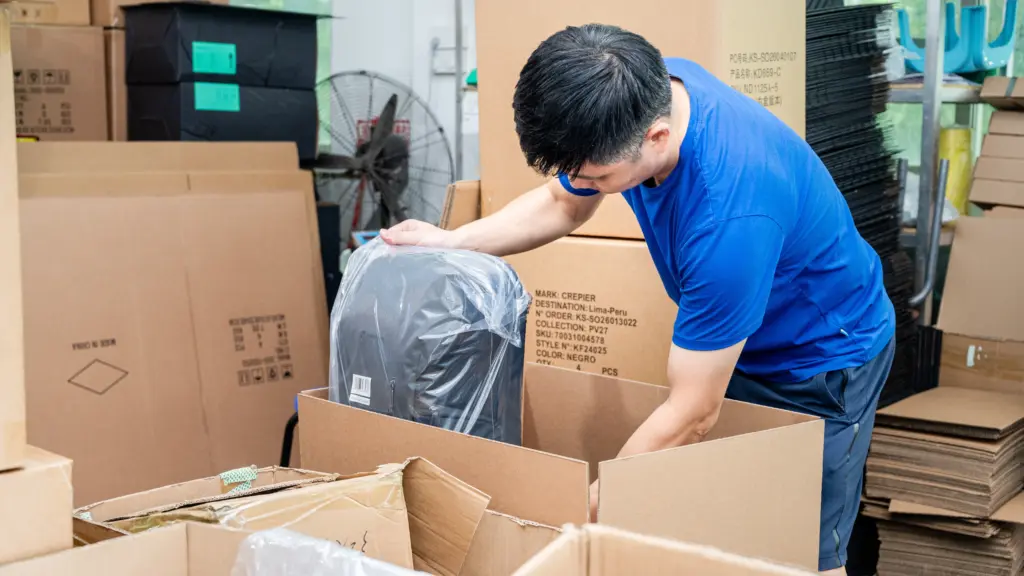
The reason is volume. A 500-unit order of backpacks needs 500 poly bags, 500 scannable labels and correctly built master cartons. Doing that work in a garage or a US prep center means paying domestic labor rates per unit, plus a second touch of every bag. Doing it at the factory adds minutes to a production line that is already packing the goods — the bag goes from final inspection into its poly bag, the label goes on, the carton gets built to spec.

Getting it wrong is no longer a rounding error. 부터 2026, Amazon’s inbound defect fees have multiplied — a small standard-size unit that once cost a few cents to fix now bills at over $0.30 per defect, before relabeling or rebagging labor. A systematic pattern of non-compliant shipments can trigger receiving restrictions. The cheapest unit of prep you will ever buy is the one the factory does before the container ships.
What “FBA-ready” means for a bag
Amazon’s requirements sit at three levels, and each one has failure modes specific to soft goods:
- Unit level — the individual bag: poly bagged, sealed, suffocation warning, scannable barcode, nothing protruding that can snag a conveyor.
- Inner level — sets and multipacks: if you sell 2-packs or gift sets, the set is the unit and must be pre-bagged and labeled as one scannable item.
- Master carton level — the box the fulfillment center actually receives: shipment labels, weight limits, no old barcodes, no strapping.
Bags add two quirks that hard goods don’t have. 첫 번째, they are compressible: a bag stuffed wrong measures differently than one packed flat, which matters when the size tier is measured in inches. 두번째, they carry hardware — zipper pulls, buckles, metal logo plates — that can poke through a thin poly bag and injure a warehouse worker, which is exactly what the bagging rules exist to prevent.
Poly bag requirements for textile bags
Amazon groups bags with apparel and other textiles for prep purposes. The requirements for the poly bag itself:
- Transparent — clear polyethylene or shrink wrap, so the barcode can be scanned through the bag or the product can be identified without opening it.
- At least 1.5 mil thick (~에 대한 0.038 mm). Thin boutique-grade bags frequently measure under spec once actually gauged; the thickness is what protects the product and the handler.
- Fully sealed — by heat, self-seal closure or tape rated for the purpose. A bag that flaps open in transit is treated as unbagged.
- Sized to the product — the bag may not exceed the product’s dimensions by more than 3 inches (7.5 센티미터) in any direction. An oversized bag on a compressible product creates slack that catches on conveyors.
- Scannable through the bag — either a manufacturer barcode (UPC/EAN) visible through the clear film, or an FNSKU label applied to the outside.
Suffocation warnings: 놓기, wording and type size
Any poly bag with an opening of 5 inches (12.7 센티미터) or more must carry a suffocation warning — printed on the bag itself or on a label affixed to it. Backpack and duffel poly bags are far past that threshold, so this applies to essentially every unit in an FBA bag shipment.
The warning must be printed in a size proportionate to the bag, conspicuous and legible, in the language of the marketplace you ship to. Amazon’s published guidance maps bag size to minimum type size:
| Bag size (length + width) | Minimum print size |
|---|---|
| 152.4 센티미터 / 60 in or larger | 24 point |
| 101.6–149.86 cm / 40–59 in | 18 point |
| 76.2–99.06 cm / 30–39 in | 14 point |
| Under 73.66 센티미터 / 29 ~에 | 10 point |
Most backpack poly bags fall in the bottom band, but oversized travel-bag and duffel bags can push into the 14-point band. The practical instruction to a factory is simple: state the bag’s flat dimensions in the PO, and require the warning to be printed or labeled at the correct size for that band.
FNSKU vs manufacturer barcode: which label goes on the bag
Every unit needs exactly one scannable identity. There are two routes:
- Manufacturer barcode (UPC/EAN) — scannable through a transparent bag, matched to your ASIN in Seller Central under the manufacturer barcode setting. Faster, no extra labeling, but any barcode on the product or its hangtag must be the one registered to that ASIN.
- FNSKU (X00-prefixed label) — Amazon’s own label, applied to the outside of the bag or over the existing barcode. Required in several situations, including commingled-ineligible products, and it is the safer default for private-label sellers because the unit is tied to your account, not pooled with other sellers of a similar product.
For private-label bag brands, most sellers choose FNSKU. The operation at the factory is trivial — your label PDF files to the factory, labels applied at the packing station — but the data must be exact: one label file per ASIN, per colorway, per size. A swapped label on a black and a navy colorway of the same backpack becomes a customer complaint and a stranded-inventory problem weeks later.
Prep categories that apply to bags
Beyond standard bagging, several of Amazon’s special prep categories touch bag sellers:
- Sharp items — bags with exposed metal logo plates, prominent buckle hardware or rack hooks may need the hardware bubble-wrapped or the whole unit bagged so nothing punctures the film or a handler.
- Adult products — an opaque black bag requirement; irrelevant to most bag lines, but it applies to certain novelty categories.
- Sets — a “laptop bag + sleeve + cable pouch” bundle is one scannable unit and must be bagged or banded as a single item that cannot separate in transit.
- Hangers — bags shipped on hangtags or hangers must be secured so the strap cannot tangle with other units; remove or tape down loose straps where practical.
None of this is exotic. It is a checklist, and the right factory runs it per SKU as part of the packing specification.
Master carton rules: the box the fulfillment center judges you by
Unit-level prep gets the product received; carton-level compliance gets the shipment received. The rules Amazon enforces at the carton:
| Requirement | What the factory must do |
|---|---|
| FBA shipment labels | Amazon-generated carton labels on a flat surface, not wrapped over edges; each carton and pallet labeled per the shipment plan |
| Old barcodes neutralized | Every existing barcode on a reused or printed carton covered with opaque tape or rendered unscannable |
| Weight limits | Cartons over 50 lb (~에 대한 23 kg) marked “Team Lift”; stick to box strength rated for stacked ocean freight |
| No strapping or staples | No packing straps, elastic bands or large staples — sealed with standard packing tape only |
| Uniform case packs | Each carton contains one ASIN in equal unit counts unless the shipment plan says otherwise; mixed-SKU cartons follow case-pack rules |
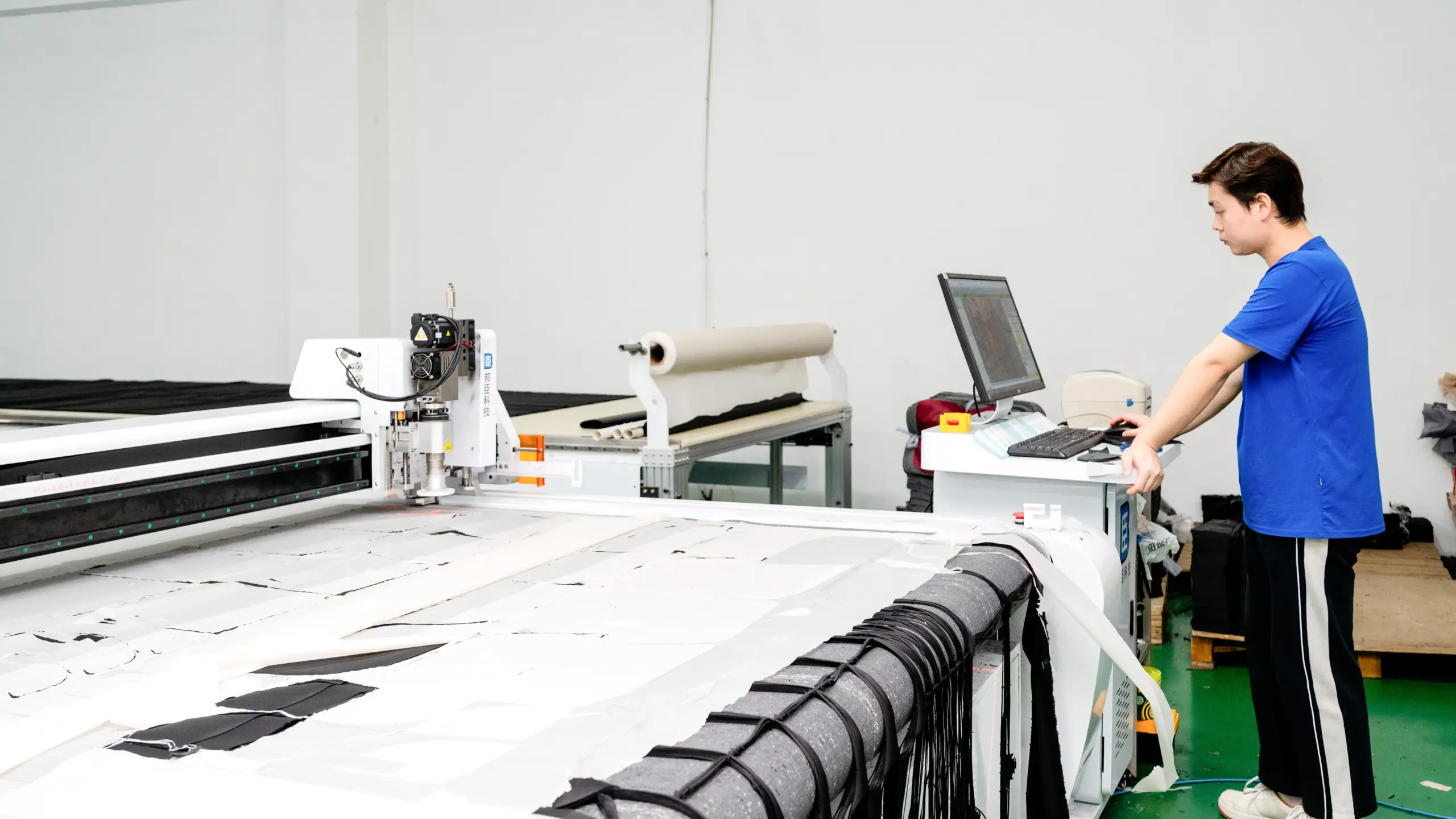
Packaging dimensions decide your FBA fee tier
The size tier your unit lands in is measured on the packaged product — the poly bag or retail box, not the naked bag. For compressible goods this creates a real decision:
- A backpack vacuum-flat in a snug poly bag can measure an inch smaller in thickness than the same bag loosely packed — sometimes the difference between size tiers.
- A rigid gift box adds volume on every dimension. If the boxed unit crosses into the next tier, you pay the higher fulfillment fee on every order, forever, until the packaging changes.
- Weight includes the packaging. 에이 900 g backpack in a 300 g gift box is a different fee animal than the same bag in a 40 g poly bag.
Run the current fee grid against both packaging options before approving a retail box. Sometimes the unboxing experience is worth the tier; often it is not. This is a merchandising decision that should be made with the fee schedule open, not discovered in the first settlement report.
Who should do the prep: seller, prep center or factory
| Prep location | Typical cost profile | Best suited for |
|---|---|---|
| In-house (seller) | Cheapest per unit, highest labor and space demand; slowest to scale | Small trials, under ~100 units |
| Amazon Prep Service | Per-unit fees by service type; convenient but the most expensive path at volume | One-off fixes, low volumes |
| Third-party prep center | Per-unit fees plus inbound freight handling; adds a US touch point | Multi-supplier consolidation, repack programs |
| Factory-direct prep | Lowest marginal cost — minutes on an existing packing line; requires a precise spec | Direct-import private label at any real volume |
For bag sellers importing factory-direct, the factory is the natural prep point: the goods are already there, the packing labor is already there, and the specification travels once — in the PO and tech pack — instead of the goods traveling twice. The earlier article on building a complete tech pack for custom bags covers the document itself; FBA prep simply adds a packaging annex to it.
What to write into the PO: the FBA packaging annex
An FBA-ready purchase order is explicit about packaging in the same way it is explicit about materials. Minimum contents:
- Unit packaging spec — poly bag material, thickness (1.5 mil minimum), transparency, dimensions relative to the product, seal method, suffocation warning printed or labeled at the correct type size.
- Labeling spec — FNSKU or manufacturer barcode decision per ASIN; label file versions supplied by the seller; 놓기 (outside the bag, flat, unobscured); one ASIN per carton during packing to prevent label swaps.
- Carton spec — carton dimensions and burst strength, units per carton, weight ceiling, Team Lift marking above 50 lb, tape-only sealing, old barcode neutralization, and Amazon shipment labels applied per the shipment plan (or supplied labels applied at the factory).
- Data deliverables — per-ASIN packed dimensions and weights after packaging, case-pack configuration, and photos of a packed sample carton for approval before bulk packing.
- Sample gate — one fully prepped production sample per ASIN approved by the seller before the line packs the balance.

Sellers who skip the sample gate are the ones who discover, at the fulfillment center, that the factory applied 40-point warnings to small bags (harmless) or bagged the product with the hangtag barcode facing inward (not harmless). A photo of one approved prepped unit eliminates the entire failure class.
How Kingsons supports FBA sellers
Kingsons runs a dedicated packing workshop as the final stage of its production flow, with automated packaging, labeling, carton-sealing and barcode-scanning equipment on the line. For FBA sellers this means prep instructions can be executed where the goods are packed rather than subcontracted after arrival:
- Standard export packing as the baseline — individual poly bag, inner boxes of 6–12 units, master carton — which maps naturally onto FBA unit-plus-carton requirements.
- 맞춤형 소매 포장 — gift boxes and branded packaging available as a quoted option when a boxed presentation justifies its fee tier.
- Sustainable packaging options — FSC-certified packaging is listed among the company’s material options for brands building an eco positioning.
- Scale and cadence — 20 production lines and a 300,000-unit monthly capacity keep case-pack runs consistent, and delivered terms (FOB, CIF, CFR, DDP) allow routing straight to the Amazon inbound channel you nominate.
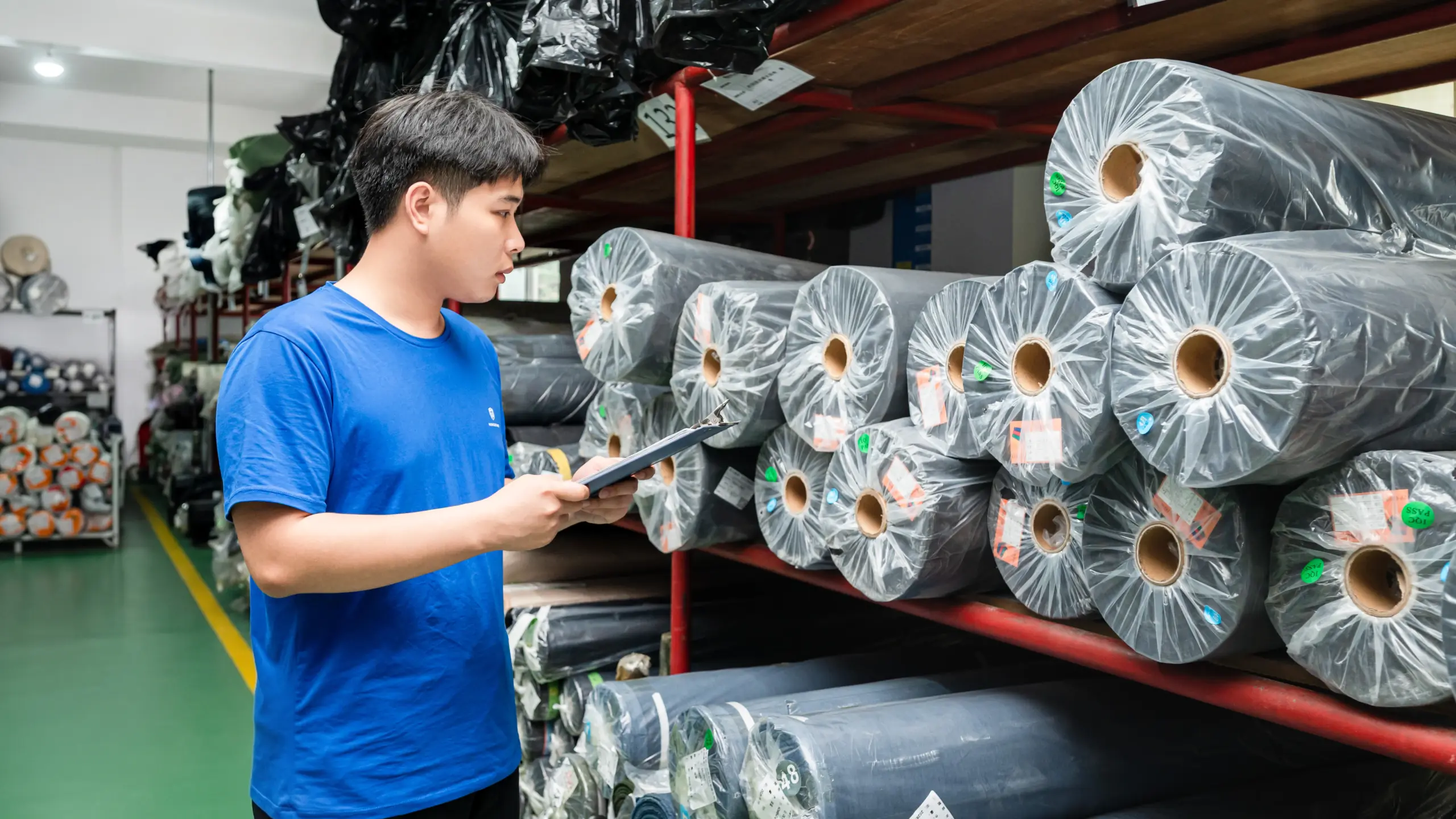
Because prep is executed inside the factory’s own quality flow, the same people who ran final inspection on a batch also pack it — the unit that passed QC is the unit that gets bagged, labeled and sealed, with barcode scans recorded at the packing table.

FBA packaging also interacts with product compliance: chemical and product-safety documentation for US sales is a separate track from packaging prep, covered in REACH and CPSIA compliance for bags, and prep cost lines belong in the budget model described in how bag manufacturing costs are built.
Red flags when vetting an FBA-capable bag factory
- Cannot quote prep as a line item — a factory that has never bagged to a spec will quote “normal export packing” and treat FBA rules as your problem at destination.
- No labeling capability or barcode scanning at packing — if labels are applied by hand without scan verification, expect swaps at scale.
- Refuses a prepped sample photo or sample gate — the single cheapest control in the whole process; refusal is disqualifying.
- Rigid about packaging options — you want a partner that can poly-bag one SKU, gift-box another and quote both, not a one-size export pack.
- No export-documentation fluency — DDP or CIF shipments to Amazon inbound nodes need paperwork precision; fumbled documents cost more than fumbled bags.
자주 묻는 질문
Do backpacks have to be poly bagged for FBA?
예. Amazon treats bags as textiles, and textile products must arrive individually bagged in a transparent, sealed poly bag of at least 1.5 mil, with a scannable barcode and a suffocation warning when the opening is 5 inches or larger. Unbagged units get flagged for unplanned prep and billed accordingly.
Should I use FNSKU labels or my manufacturer barcode?
For private-label sellers, FNSKU is the safer default: each unit is tied to your account rather than pooled. Manufacturer barcodes readable through the bag save a labeling step but require that the product’s barcode is the exact one registered to your ASIN. Decide once, per ASIN, and put the decision in the PO — mixing the two on one shipment is a receiving problem.
Is it cheaper to prep at the factory or at a US prep center?
At the factory, for any meaningful volume. Prep at the factory adds minutes to a packing line that is already handling the goods; a US prep center adds per-unit service fees plus an extra freight touch for every bag. The factory route costs you precision in the spec instead of cash per unit — write the packaging annex and require a prepped sample photo before bulk.
Can the factory apply Amazon shipment labels to cartons?
예, when the workflow supports it: the seller generates the shipment plan in Seller Central, sends the carton label files, and the factory applies them to flat carton surfaces with old barcodes neutralized. Many sellers have the factory build and label cartons to the case-pack spec, then apply final shipment labels themselves or at a consolidator — both work; the spec just has to say which.
What happens if my FBA shipment arrives non-compliant?
Amazon charges unplanned prep or inbound defect fees per affected unit — fees that rose sharply in 2026 — and may relabel, rebag or, for carton-level violations, refuse the inventory. Repeated patterns can bring receiving restrictions. Every one of these outcomes costs multiples of doing the same work at the factory packing table.
Does Kingsons ship FBA-ready bag orders?
Kingsons packs on a dedicated line with automated packaging, labeling, sealing and barcode-scanning equipment, and its standard export packing — individual poly bag, inner boxes, master carton — aligns with FBA unit and carton structure. FBA-specific requirements such as FNSKU files, suffocation-warning sizing and case-pack configuration are executed per order spec; FSC-certified packaging is available among its options. Submit your packaging annex with your inquiry and confirm the prepped sample before bulk production.
Ship bags that pass receiving the first time — specify FBA prep at the factory and confirm a prepped sample before bulk.